

The most reliable way to move guests to and from an event in Los Angeles is pre-arranged private chauffeur transportation, booked early and built around a written run sheet: who is picked up, where, when, and by whom. Los Angeles distances, venue rules and traffic punish improvisation, and a guest who is late or lost reflects on whoever arranged the event. Hepilot provides pre-arranged chauffeur service for special events, business transportation and hourly bookings across Los Angeles and Southern California. This guide gives you the planning routine we would hand to an executive assistant, office manager or concierge desk.
TL;DR
- Decide the shape of the event first: one arrival wave or many, one venue or several, who needs assistance. Everything else follows from it.
- Write a run sheet with exact pickup points, venue drop-off points, buffers and a named contact for every vehicle.
- Check venue rules for vehicle staging and drop-off before you book. Large venues publish them and enforce them.
- Ask each quote what is included: waiting time, luggage help, extra stops, gratuity and cancellation terms.
- Book early, name a backup, and give every guest one clear message with the driver’s details.
Table of Contents
- What event transportation covers
- Start with the guest list and the shape of the event
- Plan pickup and drop-off points, timing and stops
- A run sheet that works
- What to confirm before you book
- Accessibility, luggage and passenger comfort
- Understanding the cost of event transportation
- Plan for delays and changes
- Book chauffeured event transportation with Hepilot
- Our perspective: transportation is part of the event
- FAQ
- Sources
What event transportation covers
Event transportation is any pre-arranged movement of people tied to a gathering: a corporate dinner, a conference, an offsite, a wedding, a gala, a product launch or a private celebration. It usually includes some mix of these:
- Arrivals: airport pickups for out-of-town guests, speakers or executives, often with a driver meeting them inside the terminal.
- Transfers: hotel to venue, venue to dinner, venue to hotel at the end of the night.
- Hourly service: a vehicle and chauffeur kept at your disposal for a block of time, useful when the schedule has several stops or may shift.
- Assisted transportation: extra support for seniors and passengers who need a steadier arm, help with bags or a slower pace.
These map to the services we offer: airport transfers, business transportation, special events and assisted transportation, plus hourly chauffeur service. Most real events combine two or three of them, which is why a single coordinated booking is easier to manage than several unrelated ones.
Start with the guest list and the shape of the event
Before you request a quote, answer five questions on one page.
- How many people, and in how many groups? Ten executives arriving separately need a different plan than forty guests leaving a venue at once.
- Where do they start? Airport, hotel, office or home. Mixed starting points mean mixed pickup times.
- Where does it end? Back to the hotel, to the airport, or home. Departures are where most plans get thin.
- Who needs extra help? Seniors, guests with mobility needs, anyone with heavy luggage or equipment.
- Who is the contact on the day? One named person who can answer a driver’s call and make decisions.
Group size matters because it decides how many vehicles and chauffeurs you need and how staggered the pickups should be. Our fleet page shows the vehicle options, so you can match them to your headcount before you ask for a quote.
If you are arranging this for an executive rather than a whole group, our executive travel planning guide for assistants covers the itinerary side in more detail.
Plan pickup and drop-off points, timing and stops
Choose pickup points that a driver can actually reach
A pin on a map is not a pickup plan. For each pickup, record the exact door, lobby or terminal, a phone number for the guest and a fallback if the first spot is blocked. At crowded places such as LAX, a driver the guest can identify immediately saves the most time. Clear driver identification and meet and greet are part of what we do, and our page on LAX meet and greet service explains how arrivals work in practice.
Check the venue’s own rules
Large venues do not leave vehicle access to chance. The Los Angeles Convention Center’s event planning guide lists bus staging capacity on its private drives: 60 buses on Gilbert Lindsay Drive, 70 on Figueroa Drive and 70 on Pico Drive. It also says venue security staffing at each access gate is required whenever those drives are in use, and that the staffing is billable to the licensee, meaning the party holding the event. For events expecting 1,000 or more daily attendees, the same guide says to discuss LAPD and/or LADOT staffing with your event manager 7 to 11 months ahead, and to submit the final security staffing and posting plan 1 to 2 months ahead.
Most corporate events are far smaller, but the lesson scales down: ask the venue where vehicles may stop, where they may wait, whether there is a loading zone, and whether any fee or permit applies. Pass the answers to your chauffeur provider in writing.
Build the timing in Los Angeles terms
The visitor bureau’s meeting planner FAQs give advice that holds for any event here: group activities by neighborhood, avoid peak travel times, and build extra time into the schedule for transportation between stops. In practice that means:
- Do not schedule a pickup and a start time as if the drive were a fixed number. Add a buffer for the time of day and the venue approach.
- Put the arrival of the first guests well ahead of the program, so the last one in is not the one who sets the clock.
- Keep stops to the ones that matter. Every extra stop adds both time and cost.
The region itself is planning around event congestion. LA Metro’s Special Event Transportation playbook, released on October 6, 2025, organizes best practices around the service plan, safety and emergency management, customer experience including accessibility and signage, and contingency planning. That is a public-transit document, but its structure is a useful checklist for any private event: purpose, service plan, safety, guest experience, backup plan.
Looking ahead, SCAG’s travel demand management resource guide, dated January 15, 2026, describes a coordinated regional effort for the 2028 Games led by LA28, the Mayor’s Office, Metro, Metrolink, Caltrans, LADOT and SCAG. If your event falls near a major citywide event, expect more road pressure and plan the schedule with extra margin.
A run sheet that works
A run sheet is a one-page schedule that everyone involved shares: you, the chauffeur provider, the venue contact and the guests’ host. Here is a simple model for a corporate dinner with out-of-town guests.
| Leg | What to record | Why it matters |
|---|---|---|
| Airport arrival | Flight number, terminal, guest name, meeting point | The driver can track the arrival and find the guest |
| Hotel pickup | Lobby door, guest phone, ready time | Prevents drivers circling while guests finish getting ready |
| Venue drop-off | Gate or entrance, staging rule, venue contact | Avoids a blocked or wrong entrance |
| Waiting window | Start and end of the driver’s hold time | Defines what the quote must cover |
| Return leg | Departure time estimate, flexible or fixed | Events overrun, so decide how the return adapts |
| Departure to airport | Flight time, pickup time, terminal | The one leg with a hard deadline |
Send the same sheet to your provider early. A chauffeur who knows the whole day drives it better than one who learns each leg by text.
What to confirm before you book
Whether you are an assistant arranging a ride for one executive or a hotel team handling a group, confirm these items in writing:
- Dates, times and locations for every leg, including the return.
- Vehicle type and number matched to passengers and luggage.
- Driver details sent to the guest ahead of time: name, vehicle and a phone number.
- Meet and greet where the guest is arriving at an airport.
- Waiting time included, and what happens if the schedule runs over.
- Special needs such as senior assistance, mobility support or extra luggage.
- Cancellation and change terms, and who to call on the day.
- A single point of contact on your side and on the provider’s side.
Hotels and concierge teams add one more: tell the front desk and the bell stand which vehicle is coming and when, so the guest is not left waiting at the wrong door.
For corporate programs with multiple legs, our corporate event transportation guide walks through this planning in more depth.
Accessibility, luggage and passenger comfort
Accessibility belongs in the plan from the first draft, not as a late patch. Ask your registration or RSVP process to flag guests who need assistance, then pass those names to your chauffeur provider with specifics: a walker, a wheelchair, a slower pace, help with stairs.
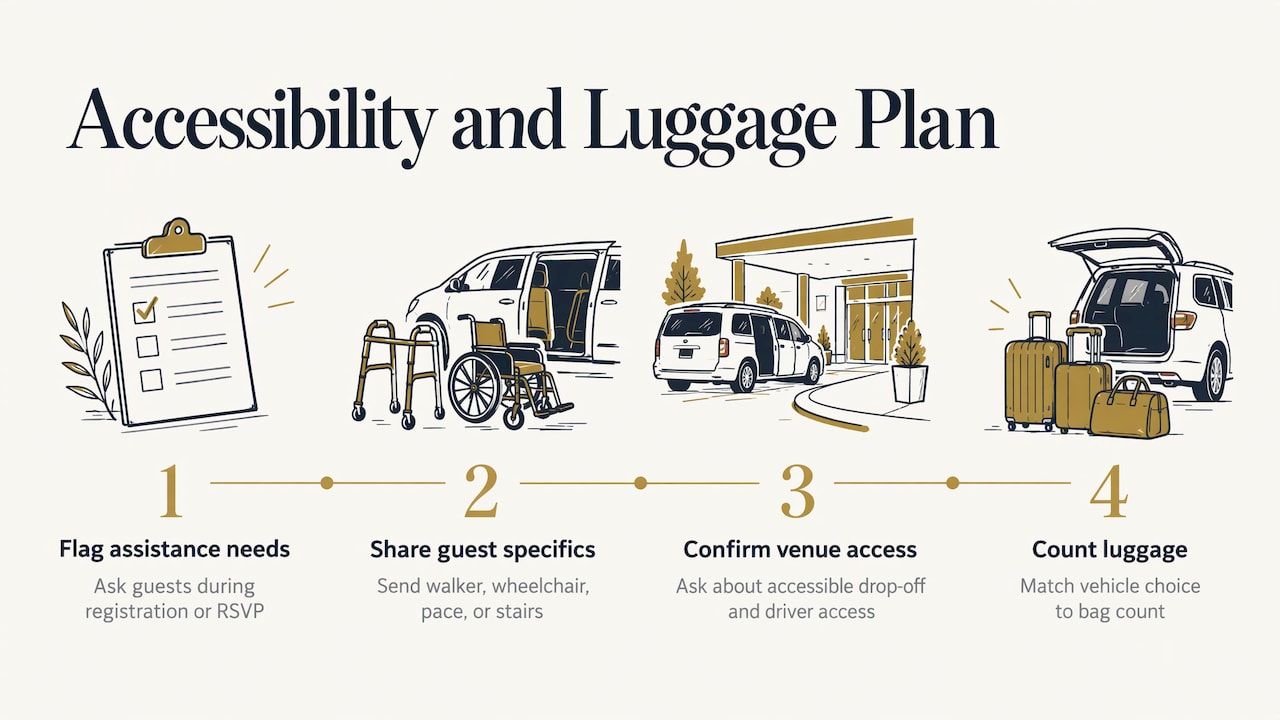
Venues vary in how they handle this. The Los Angeles Convention Center’s event planning guide states that the Center is ADA-compliant, with three Access Paratransit drop-off points: #4080 on Pico Drive, #4081 on Gilbert Lindsay Drive and #4082 on Pico Boulevard. It also notes that the licensee is responsible for non-permanent accessibility such as seating and auxiliary aids, and that bag and luggage check is available through its Business Services Center. Whatever the venue, ask where accessible drop-off is and whether the driver can reach it.
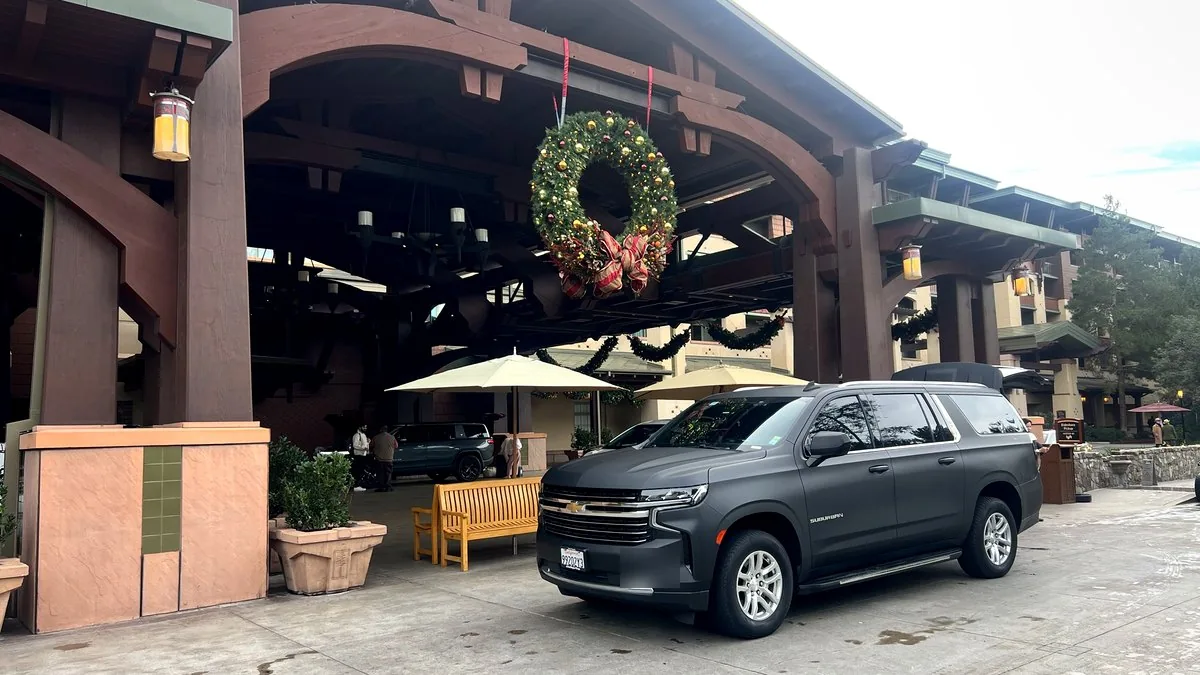
On our side, assisted transportation for seniors and passengers who need extra support is a listed service, along with professional luggage assistance. If a senior guest is flying in for your event, our guide to airport transportation for seniors in LA sets out how to arrange it.
Luggage deserves its own line in the plan. Count bags, not only people. A group arriving for a conference has more luggage than a dinner party, and the vehicle choice should reflect it.
Understanding the cost of event transportation
Prices differ by event, so a good quote spells out what the figure includes. When you compare quotes, look at:
- Service type: a one-way transfer, a round trip or an hourly booking are priced differently.
- Duration and waiting time: how many hours are included and how overtime is handled.
- Vehicle: a larger or higher-specification vehicle changes the figure.
- Number of stops and distance: extra pickups or a venue far from the starting point.
- Timing: late-night, early-morning or holiday service.
- Airport pickups: whether meet and greet and parking are included.
- Gratuity, taxes and fees: included, or added afterward.
- Cancellation and change terms: what happens if the program shifts.
Transparent pricing is part of how we describe our service, and our page on what you pay for chauffeur service and why explains the factors behind a quote. Send your run sheet with the request and the quote will reflect the real day instead of a guess.
Plan for delays and changes
Events rarely run exactly to schedule. A contingency plan costs little to write:
- Make the return leg flexible. Book hourly service or an open window rather than a fixed minute when the end time is uncertain.
- Share live contact numbers. The driver, the on-site host and you should all be reachable by phone.
- Track arrivals. For airport pickups, give flight numbers so the pickup adjusts to the actual landing time.
- Agree a decision rule. If a keynote runs twenty minutes long, who decides whether the next transfer waits?
- Brief guests once. One message with the pickup point, the driver’s details and the contact number beats three partial ones.
Book as early as the event allows. Early booking gives you more choice of vehicles and time to resolve venue questions, particularly around busy periods.
Book chauffeured event transportation with Hepilot
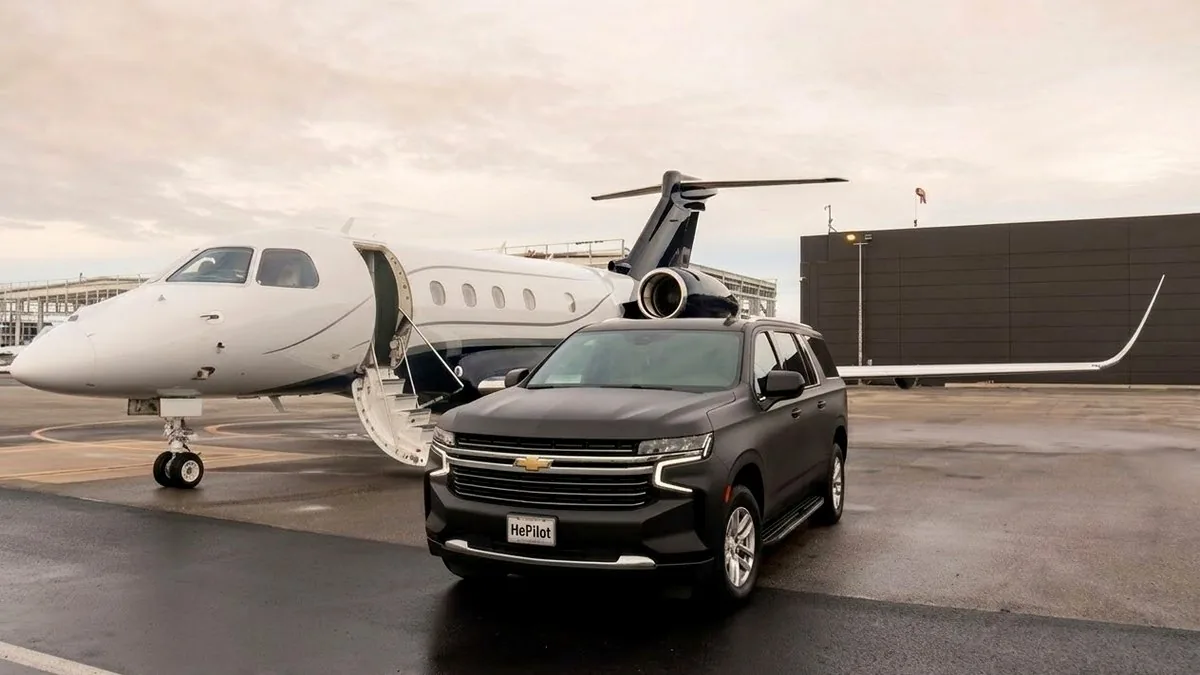
We provide pre-arranged private chauffeur transportation for special events, business travel, airport transfers and hourly service across Los Angeles and Southern California. Our chauffeurs are professional and easy to identify at crowded locations like LAX, we assist with luggage, and we provide complimentary bottled water. To arrange transportation for an event, see our services or book hourly chauffeur service through our booking page.
If your event includes a wedding party, our wedding car service guide covers that planning separately.
Our perspective: transportation is part of the event
Guests rarely remember the route. They remember whether someone was there when they stepped out of the terminal, whether the driver knew their name, and whether they reached the venue calm and on time.
That is why we treat event transportation as a pre-arranged service, not a ride request. A chauffeur who has the run sheet, knows the pickup point and can be recognized at a crowded arrivals curb removes the small failures that make an event feel disorganized.
We built our service around punctual pickups, professional chauffeurs, luggage assistance and clear driver identification, with premium vehicle options and transparent pricing. For executive assistants, office managers and concierge teams, that means one booking you can hand over and trust, instead of a day spent tracking separate rides.
The better you brief us, the better the day runs. Send the guest list, the venue and the timing, and we will help you shape the plan.
Hepilot
FAQ
How far ahead should I book event transportation in Los Angeles?
Book as soon as the date, venue and rough headcount are fixed. Early booking gives you more vehicle choice and time to settle venue access rules. Large venues can require planning months ahead for staffing and access, so check the venue’s guide first, and confirm final details with your chauffeur provider once the guest list is firm.
What should I send a chauffeur provider to get an accurate quote?
Send a run sheet: dates, pickup and drop-off addresses, flight numbers for airport legs, passenger and bag counts, waiting time, special assistance needs and a contact on the day. The more complete the schedule, the more accurately the quote reflects the actual event.
Is hourly chauffeur service better than separate transfers for an event?
When the schedule has several stops or an uncertain end time, hourly service keeps one vehicle and chauffeur available for the whole block, so you adjust on the day without rebooking. For a single fixed airport pickup, a pre-arranged transfer is the simpler fit.
How do I arrange transportation for guests who need extra help?
Identify those guests early, ideally through your RSVP process, and tell your chauffeur provider exactly what support each needs. We offer assisted transportation for seniors and passengers who need extra support, along with luggage assistance, so the help is arranged before the guest arrives.
Sources
- LA Metro: Special Event Transportation playbook announcement
- Los Angeles Convention Center Event Planning Guide
- Discover Los Angeles: Meeting Planner FAQs
- SCAG TDM Resource Guide, January 15, 2026
Pingback: Transporte corporativo: cómo organizarlo bien en Los Ángeles - HePilot Chauffeur Service
Pingback: Chauffeur Etiquette: What to Expect and How Much to Tip | HePilot