
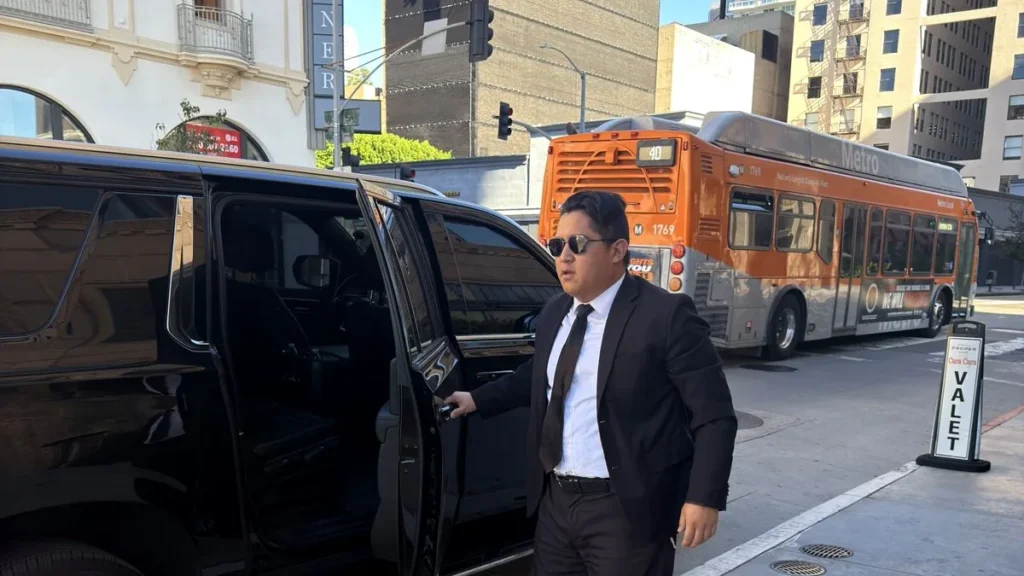
Chauffeur etiquette is a two-way arrangement. A professional driver greets you properly, handles your bags, drives smoothly and keeps what they hear to themselves. You give accurate trip details, a clear pickup point and, in the US, a gratuity. If you book rides for executives, clients or hotel guests, knowing both sides lets you set the right expectations before the car arrives. It also shows you quickly whether a company is doing its job.
This guide covers what a good chauffeur does, how passengers and the people who book for them can make the ride go well, and what to tip. At HePilot we drive private clients across Los Angeles and Southern California, so the examples lean toward LAX arrivals, office pickups and event nights.
TL;DR
- A professional chauffeur confirms your name and destination, keeps you updated at pickup, handles luggage, dresses to a business standard and treats what they hear as private.
- Passengers help most by giving flight numbers, passenger counts and exact pickup points ahead of time, and by telling the driver about special needs when booking.
- For a privately hired car in the US, AAA suggests 10% to 15% of the fare, and the Emily Post Institute suggests 20%. Many private-car customers land at 15% to 20% for good service.
- If a gratuity is already on your confirmation, an extra tip is a personal choice, not an obligation.
- Executive assistants and concierges should put every detail in the booking, so the driver never has to guess.
Table of Contents
- What a professional chauffeur does before you get in
- Greeting, doors and luggage: the rituals and what they mean
- Attire and grooming
- Privacy and discretion in the cabin
- Safe driving is part of etiquette
- Passenger etiquette: how to be a good client
- How much to tip a chauffeur in the US
- Etiquette for assistants, office managers and concierges
- Book a ride that follows these standards
- FAQ
- Sources
What a professional chauffeur does before you get in
Most etiquette is decided before the car door opens. The Houston Limousine Association’s professional standards for chauffeurs describe the baseline: a professional greeting that confirms the passenger’s name and destination, proactive updates when the driver is arriving, staging and loading, and clear pickup instructions at airports, hotels, venues and cruise terminals.
In practice, that means a few things you can expect:
- The driver is early, not just on time. Staging near the pickup point means you never wait while someone circles the terminal.
- You are told where to find the car. At a crowded arrivals curb, a driver who tells you where they are, and is easy to identify, saves ten minutes of searching.
- Your name is confirmed. It protects against the wrong passenger getting into the wrong car, which matters most at busy hotels and airports.
- Luggage is handled by the driver. You should not have to lift a bag.
The handoff at pickup is where chauffeur work resembles any careful logistics job. Even car pickup and delivery for a stored vehicle depends on updates on arrival, a clear meeting point and confirmation that everything is ready, and the same discipline applies to passengers and their bags.
For LAX in particular, a named driver who meets you at a defined spot removes the most stressful part of arriving. Our page on LAX meet and greet service explains how that works.
Greeting, doors and luggage: the rituals and what they mean
Some chauffeur habits look like theater until you know the reason. They are really about reassurance.
Rolls-Royce’s chauffeur Andi McCann, interviewed in MotorTrend’s White Glove program feature, says to load all the luggage first and make sure the passenger sees everything go in, because a traveler with doubts will not enjoy the trip. After a reassuring look, the driver flips the rearview mirror up to give the passenger more privacy. A small habit, but it tells the passenger that the driver is aware of the cabin without watching it.
The same feature answers a question people often ask: why do chauffeurs walk around the back of the car rather than the front? In Rolls-Royce’s training, drivers go around the rear so the hood ornament stays in view. For most other cars, the habit is simply courtesy and tidiness: the driver crosses behind the vehicle and opens your door from the curb side.
What you should expect from the door to the trunk:
- A greeting that uses your name or your company’s name.
- The door opened for you, and for older passengers or anyone who needs support, a steady hand and time to get in.
- Every bag loaded by the driver, with you able to see that nothing is left behind.
- A short question about temperature or music, then quiet unless you want to talk.
If you or a guest is a senior or needs extra help, say so when you book. Our airport transportation for seniors page covers how that is arranged in LA.
Attire and grooming
The Houston Limousine Association’s standards call for clean, pressed business attire or an approved uniform, professional grooming and hygiene, clean polished shoes, and visible identification when a venue or client requires it. Visible identification is worth noting for assistants and concierges, because it is the quickest way for a guest to confirm the right driver.
A useful rule of thumb: the driver should dress one step more formally than the people they carry. A dark suit for an executive pickup, an approved uniform or business attire for a gala. Anything rumpled, scuffed or casual is a signal the company’s other standards may slip too.
Privacy and discretion in the cabin
Executives take calls, review documents and talk about deals in the back seat. The same Houston standards list privacy and discretion as part of the job, especially for executives. For you, that translates into three expectations:
- The driver does not repeat anything heard in the car, to anyone.
- The driver does not start conversation unless you invite it.
- The driver does not comment on your guests, your destination or your schedule, and does not take photos.
Passengers can help by saying early what they want. A simple “I need to take calls on the way” lets a driver adjust the audio and stay quiet. If you want conversation, a quick hello is usually enough to start.
Safe driving is part of etiquette
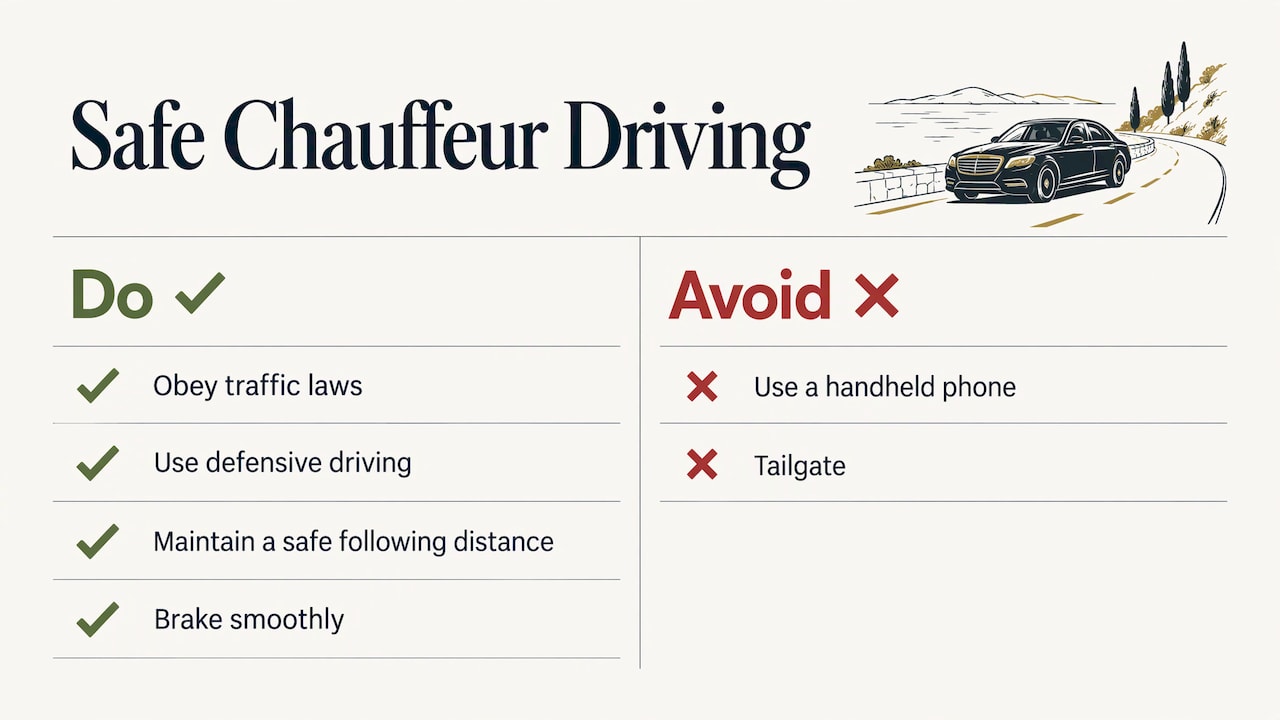
Etiquette in a chauffeured car includes how the car moves. The Houston standards say a professional obeys traffic laws and drives at safe speeds, uses defensive driving and hazard awareness, avoids distracted driving including phone use, and keeps a proper following distance with smooth braking.
Smooth braking is the part passengers feel most. If you are reading a briefing or sipping coffee on the 405, the ride should be calm enough that you never notice the traffic. Vehicle upkeep supports this as well, from brakes to something as basic as proper tire pressure, which helps a car feel stable on the road.
If a driver ever takes a call on a handheld phone or tailgates, treat it as a service failure and report it to the company.
Passenger etiquette: how to be a good client
Chauffeurs work best with passengers who are prepared. These habits help every ride, and none of them take long.
Before the ride
- Give complete details. Flight number, terminal, number of passengers, number and size of bags, and any child seat or accessibility need.
- Name the exact pickup point. “The hotel” is not enough when there are two entrances. “Main lobby, Wilshire side” is.
- Share a contact number that will be answered. Assistants should list their own and the traveler’s.
- Tell the company about changes early. A moved meeting or a delayed flight is routine for a chauffeur when the company knows.
During the ride
- Wear your seat belt. California law requires it for passengers in the back seat, and a chauffeur will remind you.
- Keep food and drinks simple and tell the driver if something spills.
- Ask for route or temperature changes politely. Drivers expect that.
- Keep to the agreed number of passengers and stops. Extra stops are easy to add when the driver knows in advance, and difficult to add on the spot in traffic.
After the ride
- Check the seat and floor for phones, laptops and passports before you step out.
- Thank the driver by name if you can.
- Settle the gratuity at the time, or confirm it with the company if it is billed later.
How much to tip a chauffeur in the US
There is no law that sets a chauffeur gratuity, so published guidance differs a little. Two well-known etiquette sources give ranges that overlap:
| Source | Suggested gratuity for a hired car |
|---|---|
| AAA tipping etiquette | 10% to 15% of the fare for cabs and limousines, 15% or more for an attentive driver who goes beyond the norm |
| Emily Post Institute tipping guide | 20% of the cost of the car for a town car or limousine |
In practice, treat 15% as the floor for a smooth ride and 20% as the figure for a ride where the driver handled heavy luggage, waited through a delay or solved a problem for you.
A worked example: a $200 airport transfer at 15% is $30, and at 20% is $40. If the driver loaded six bags and waited forty minutes for a delayed flight, 20% is easy to justify.
The Emily Post guide adds a point that matters for assistants and hosts: when you offer your driver to a guest, the host pays the tip. When you hire the car yourself, you pay it. So if you book a car for a visiting executive, decide in advance who covers the gratuity and say so in the booking. Otherwise the guest may wonder whether they are expected to tip.
If gratuity is already included
Check your confirmation. If it lists a gratuity or service charge, the driver’s tip is covered by that line, and an extra amount is up to you. If it does not, the standard ranges above apply. If you are unsure, ask the company before the ride, not the driver at the curb. For corporate accounts, a company that puts the gratuity policy in writing spares your assistant a question from every traveler.
Why Americans tip at all
Cornell professor Michael Lynn, quoted in CNN’s guide to tipping in the US, describes tipping as a social contract that visitors accept when they arrive, and says people tip for approval, to avoid guilt and out of a sense of duty, not only to reward service. For international guests, a short note in the itinerary explaining the custom is a kindness.
Etiquette for assistants, office managers and concierges
If you book rides for others, you set the tone. A few habits make the difference between a smooth pickup and a phone call from a stranded guest:
- Put the traveler’s name on the booking, spelled the way it appears on their ID. The driver will confirm it at pickup.
- Add the flight number and the airline, not only the time. Flights shift, and the driver can track them.
- Brief the traveler. Send the driver’s name, vehicle details and contact number the day before.
- State preferences once. Quiet ride, calls in the car, water, a stop for coffee: write it down so it travels with the booking.
- Decide the tip policy. Say whether the gratuity is covered, so the guest is not left guessing.
- Plan for waiting. For multi-stop days and events, an hourly booking beats a series of single trips. Read about our hourly chauffeur service and how event nights are planned in event transportation in Los Angeles.
For airport days, our guides on the airport chauffeur service and car service to LAX lay out the booking details you should have ready.
Our view: etiquette is a system, not a personality
Good manners in a chauffeur are not an act. They are the result of a service built so that nothing surprises the passenger. Clear driver identification matters at LAX because a tired traveler on a crowded curb should be able to find the right person in seconds. Luggage assistance matters because it is the first thing a guest notices. Punctual pickups matter because an executive’s day starts there.
We build our service around those points: professional chauffeurs, easy identification, premium vehicle options, attentive support for seniors and passengers who need extra help, and complimentary bottled water. For assistants and hotel teams, the benefit is simple. You hand over the details once, and the person at the curb already knows what to do.
The best test of chauffeur etiquette is what you do not have to think about during the ride.
Hepilot
Book a ride that follows these standards
If you want the etiquette above built into every trip, HePilot provides pre-arranged airport transfers, executive and corporate transportation, hourly chauffeur service and event transportation across Los Angeles and Southern California. You can see the full range on our services page, browse the vehicle options, and read how pricing works in what you pay and why. Bookings are made on the website or by phone.
For a first trip, give us the pickup point, the passenger count and any special needs, and we will arrange the rest.
FAQ
Am I supposed to tip my chauffeur?
Yes, in the US a gratuity is customary when you hire a car yourself. AAA suggests 10% to 15% of the fare, with more for an attentive driver, and the Emily Post Institute suggests 20%. If you are the host who arranged the car for a guest, the host usually covers the tip.
Should I tip if gratuity is included?
Check whether your confirmation lists a gratuity. If it does, the tip is already covered and anything extra is your choice, for example after exceptional service with heavy bags or a long wait. If you are unsure, ask the company before the ride.
Why do chauffeurs walk around the back of the car?
In Rolls-Royce’s chauffeur training, drivers go around the rear to keep the hood ornament in view. More broadly, it is a courtesy habit: the driver stays out of the passenger’s path and reaches the door from the curb side.
What is proper attire for a chauffeur?
Clean, pressed business attire or an approved uniform, polished shoes, neat grooming and visible identification when a venue or client requires it. A dark suit is the usual choice for corporate pickups.
What should I tell the company when I book?
Give the passenger’s name, flight number, terminal, number of passengers and bags, the exact pickup point, a working phone number and any accessibility or comfort needs. The more the driver knows in advance, the less you have to explain at the curb.
Sources
- Chauffeur Professional Standards, Houston Limousine Association
- Rolls-Royce White Glove Program: Driving Miss One Percent, MotorTrend
- Tipping Etiquette, AAA Club Alliance
- Tipping, Emily Post’s Etiquette
- U.S. tipping guide: Expert advice on when, where, how much, CNN
- Car Pickup and Delivery for Stored Collector Cars, NapGarage
- Why Proper Tire Pressure Matters, J & J Llantas