
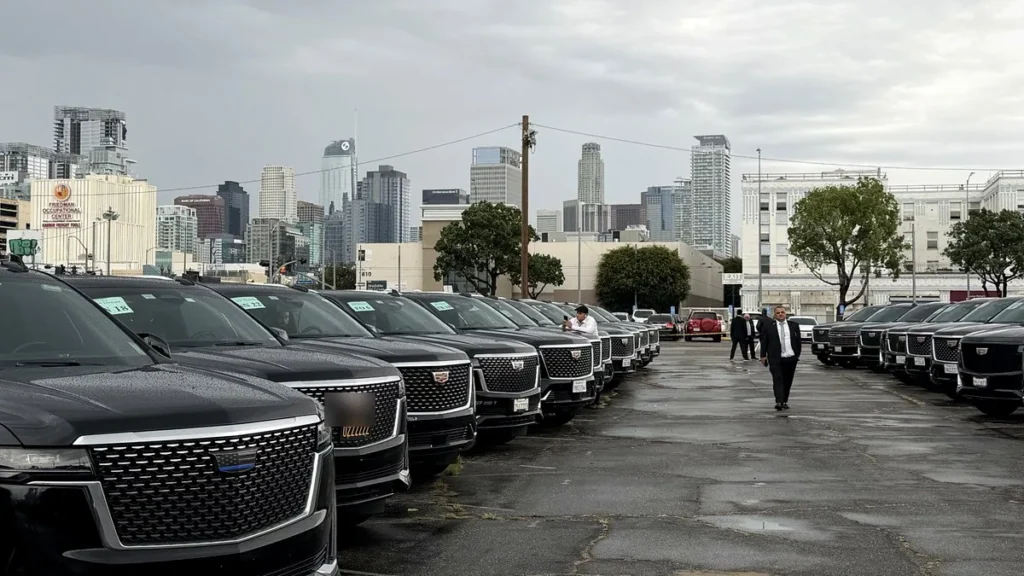
Corporate event transportation is the planned movement of attendees, executives, speakers and guests between airports, hotels and venues so that everyone arrives on time and the event starts on schedule. Good planning comes down to five things: who needs to move, from where to where, at what times, in which vehicles, and what happens when something slips. This guide walks through each one, with a Los Angeles and Southern California lens.
TL;DR
- Map every movement first: airport arrivals, hotel to venue, venue to dinner, and departures. Then match vehicles to each group.
- Build the schedule from real travel times and confirm pickup points, signage and a named contact for each leg.
- Quote requests get accurate answers when they include dates, times, passenger counts, luggage, stops and waiting time.
- Use private chauffeurs where punctuality, privacy and a polished arrival matter most: executives, speakers, VIP guests and airport meet and greet.
- Verify that any provider holds the right California and federal authority, and plan backup for flights, traffic and last-minute changes.
Table of Contents
- What corporate event transportation covers
- Start with a movement map
- Choose vehicles by group size and purpose
- Coordinating travel logistics from routes to attendee messages
- What affects cost, and what to put in a quote request
- Hourly service for event days
- Safety, licensing and contingency planning
- Perspective
- How Hepilot supports corporate events
- A planning timeline you can copy
- Common mistakes to avoid
- FAQ
- Sources
What corporate event transportation covers
The phrase covers more than a ride to the venue. In practice a corporate event usually has several transport layers:
- Arrivals and departures. Attendees land at LAX, Burbank, Long Beach, John Wayne or Ontario and need to reach hotels or the venue.
- Hotel to venue shuttles. Daily loops for conferences, trade shows and offsites.
- Executive and speaker movement. Tight, time-critical rides between meetings, green rooms and airports.
- Evening events. Dinners, receptions and awards nights, often with a different pickup point and a late return.
- Support for people who need extra help. Seniors, guests with limited mobility, and anyone traveling with heavy luggage or equipment.
Teams also use transportation as part of the experience itself. One retreat-planning guide notes that a shared ride to a retreat venue can become informal bonding time, with teams arriving together instead of scattered. That is a useful way to think about it: the first and last hour of an event are part of the event.
Start with a movement map
Before calling anyone, write down every movement as a row in a simple sheet. For each row record:
- The group (executives, speakers, general attendees, guests).
- Headcount, plus how many bags or equipment cases they carry.
- Pickup location and exact terminal, hotel entrance or venue door.
- Drop-off location.
- Target arrival time at the destination, not just the pickup time.
- A named person on your side who can approve changes.
This sheet becomes your quote request, your driver brief and your day-of run sheet. It is also how you spot the legs that need the most care. A CEO landing at LAX at 8:40 a.m. with a 10:00 keynote is a different problem from forty attendees arriving over a full afternoon.
Choose vehicles by group size and purpose
Capacity drives the first decision. As a general reference, a full-size motorcoach typically seats 47 to 57 passengers, while minibuses seat 20 to 35. Large groups moving together on one route often use those vehicle types, and the same guide notes that for 50 or more employees the per-person cost of a shared charter is significantly lower than individual rideshares or mileage reimbursement.
Most corporate events, though, are a mix. A few people need a direct, private, on-time ride; many need a scheduled loop. Matching the vehicle to the person looks like this:
| Situation | What matters most | Typical approach |
|---|---|---|
| Executive or keynote speaker arriving by air | Punctuality, privacy, time to work or prepare | Private chauffeur with meet and greet |
| Small leadership group between offices and venue | Flexibility, shared ride, discretion | One or more premium vehicles on an hourly booking |
| VIP client guests and their companions | Comfort, polished arrival, luggage handling | Pre-arranged chauffeur transfer from airport or hotel |
| Senior guests or passengers needing assistance | Patience, help at the curb, door-to-door support | Assisted transportation with a trained chauffeur |
| Large general attendee groups on a fixed loop | Cost per head, frequency | Scheduled group shuttle |
Our work sits in the first four rows: private, pre-arranged chauffeur transportation across Los Angeles and Southern California. You can see the vehicle options in our fleet before you decide what suits each group.
Coordinating travel logistics from routes to attendee messages
The movement map tells you what to move. Logistics is making it run. A few practices matter more than the rest.
Build the schedule backward from the event
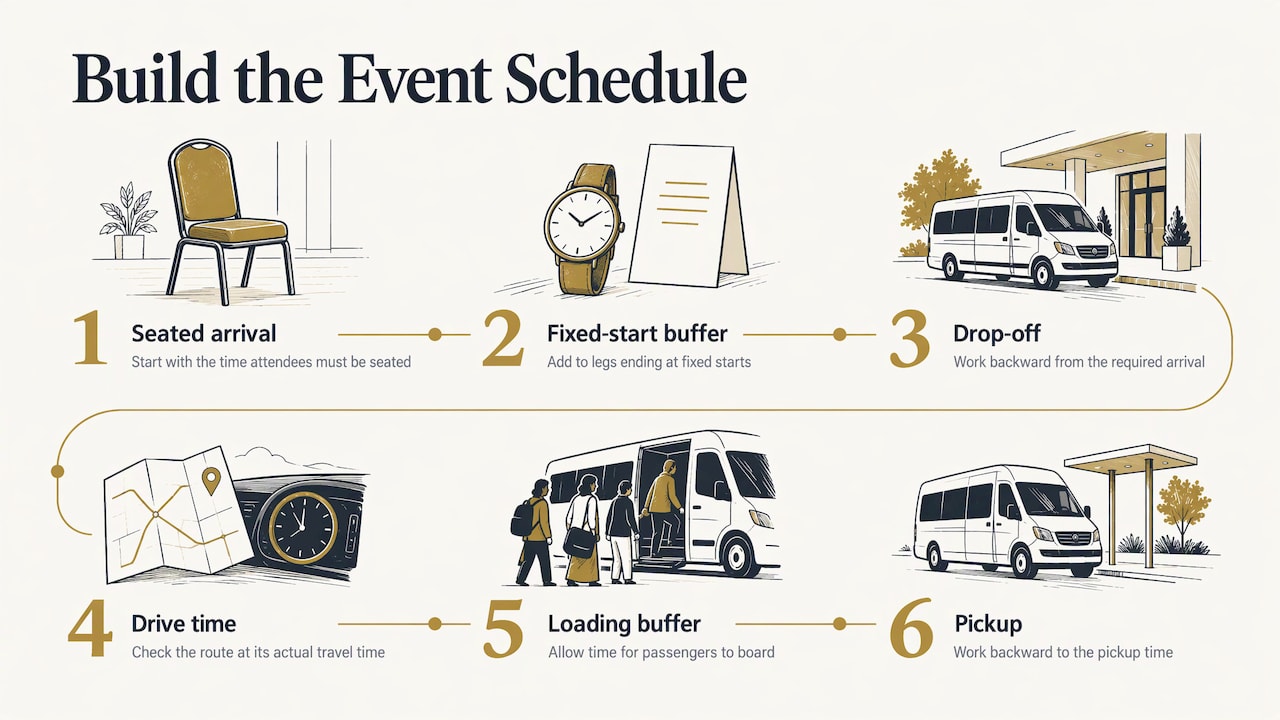
Start with the time people must be in their seats and work backward: drop-off time, drive time, loading buffer, pickup time. In Southern California, drive time depends heavily on the hour and the freeway, so check your route at the actual time of day it will run rather than relying on a distance figure. Add a buffer to any leg that ends at a fixed start time, such as a keynote or a client dinner.
Plan airports as their own project
Airports are where most corporate event transportation goes wrong, because flights move and terminals are crowded. Event planning guidance recommends that organizers estimate the travel time between the airport and the conference site, share expected attendee numbers and arrival dates with the venue, and set shuttle schedules and drop-off points. The same guidance advises confirming airport procedures for private vehicles, using airport-approved signage and placing staff where attendees can find them.
For individual arrivals at LAX, a chauffeur who waits at a known point and is easy to identify removes the most common stress: not knowing where your ride is. Our LAX meet and greet service is built around exactly that moment.
Decide which hotels to include in a shuttle loop
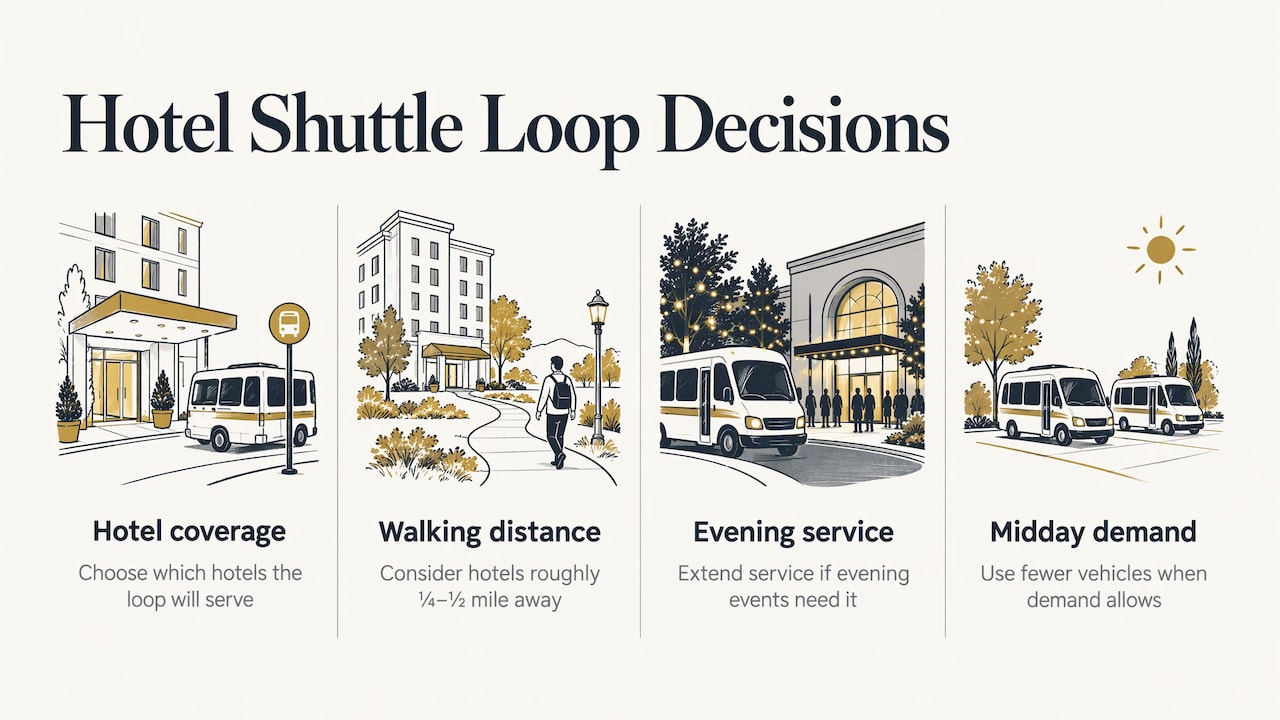
For multi-day events with a daily hotel loop, the same guidance suggests you consider which hotels to serve, whether to drop those within roughly a quarter to half a mile walking distance, whether evening events need extended service, and whether midday demand allows fewer vehicles. That last point saves money: demand is usually concentrated in the morning and evening, so a flat all-day schedule often overspends.
Communicate once, clearly, and early
Attendees need a short message, not a document. Send it 48 to 72 hours ahead and again the morning of travel. Include:
- The pickup point described in words a stranger could follow (terminal, door number, hotel entrance).
- The pickup time and how long the driver will wait.
- How to recognize the chauffeur or vehicle.
- A phone number answered by a person during the whole event window.
- What to do if a flight is delayed or canceled.
Send the chauffeur’s name and the vehicle description to the guest. Clear driver identification is especially useful at busy terminals where many drivers are waiting.
What affects cost, and what to put in a quote request
There is no single price for corporate event transportation, because the trips differ so much. The factors that shape a quote are consistent, however:
- Vehicle type and number of vehicles.
- Service type. A point-to-point transfer is priced differently from a reserved block of hours.
- Duration and waiting time. Events with idle gaps between legs are better suited to hourly service.
- Distance and number of stops.
- Airport or venue requirements, including terminal pickups.
- Passenger count and luggage, including equipment cases.
- Timing. Early mornings, late nights and peak event days.
Send all of this in the first message and you will get a comparable, accurate answer rather than a ballpark. A complete request includes:
- Event name, venue address and dates.
- For each leg: date, pickup time and place, drop-off place, passenger count and luggage.
- Flight numbers for airport pickups, so the provider can track delays.
- Whether you want point-to-point or hourly service.
- Special needs: assistance for seniors, mobility support, child seats, quiet ride for a speaker.
- Billing details and who can approve changes.
We publish no fixed rates on our site because every itinerary is different. Send us your movement map and we will quote against it. The Hepilot services page outlines airport transfers, business transportation, special events and assisted transportation.
Hourly service for event days
When an executive has several stops in one day, such as hotel, press interview, venue, client lunch and return, booking by the hour is often simpler than a series of separate transfers. The vehicle and chauffeur stay with the passenger, bags stay in the car, and the itinerary can shift when a meeting runs long. Our hourly chauffeur service is designed for this kind of day.
Safety, licensing and contingency planning
Reliability is mostly decided before the event, in two places: who you hire and what you plan for when things go wrong.
Check that the provider is properly licensed
In California, companies that charter vehicles for the exclusive use of an individual or group generally operate as charter-party carriers under the California Public Utilities Commission. Ask any provider for its carrier number and confirm it with the CPUC. Also ask about insurance and how drivers are screened and trained. A reputable provider answers these questions quickly.
Build in contingencies
- Flight tracking. Give the provider the flight number so pickup times follow actual arrival times.
- A buffer vehicle or standby chauffeur for high-stakes legs, such as a keynote speaker or board member.
- Alternate routes agreed in advance for the freeway segments most likely to back up.
- A single escalation contact on your side and on the provider’s, with phone numbers shared before the event.
- A written change policy: how late you can add, move or cancel a pickup.
- Weather and event-day closures. Check for road closures near the venue and agree on a fallback drop-off point.
Plan for guests who need extra support
Some guests need more than a curb drop-off: older attendees, people with limited mobility, or anyone arriving with a lot of luggage or event materials. Tell the provider in advance, name the guest’s needs and the pickup location, and ask who will assist at both ends. Our assisted transportation service is for exactly this situation, with attentive passenger and luggage support.
Perspective
Most transportation failures at corporate events are not about the vehicle. They are about a guest who cannot find the driver, a pickup time built on a guess, or a plan with no one to call.
That is why we focus on the details around the ride. Our chauffeurs are professionals who are easy to identify at crowded places like LAX. They help with luggage, and we provide complimentary bottled water. Pickups are pre-arranged, so the plan exists before the guest lands.
For executives, speakers and VIP guests, we believe a private chauffeur is the strongest way to protect the schedule and the first impression. The passenger arrives rested and on time, with no parking, no hunting for a ride, and no waiting in a line. Premium vehicle options let you match the vehicle to the guest, and transparent booking and pricing keep finance and assistants informed.
When a client sends a clear movement map, we can build the itinerary with them and keep one point of contact through the event.
Hepilot
How Hepilot supports corporate events
We provide private chauffeur transportation across Los Angeles and Southern California: pre-arranged airport transfers, hourly chauffeur service, executive and corporate transportation, special event transportation, and assisted transportation. Executive assistants, office managers, hotels and concierge teams use us to take transportation off their plate for the guests who matter most.
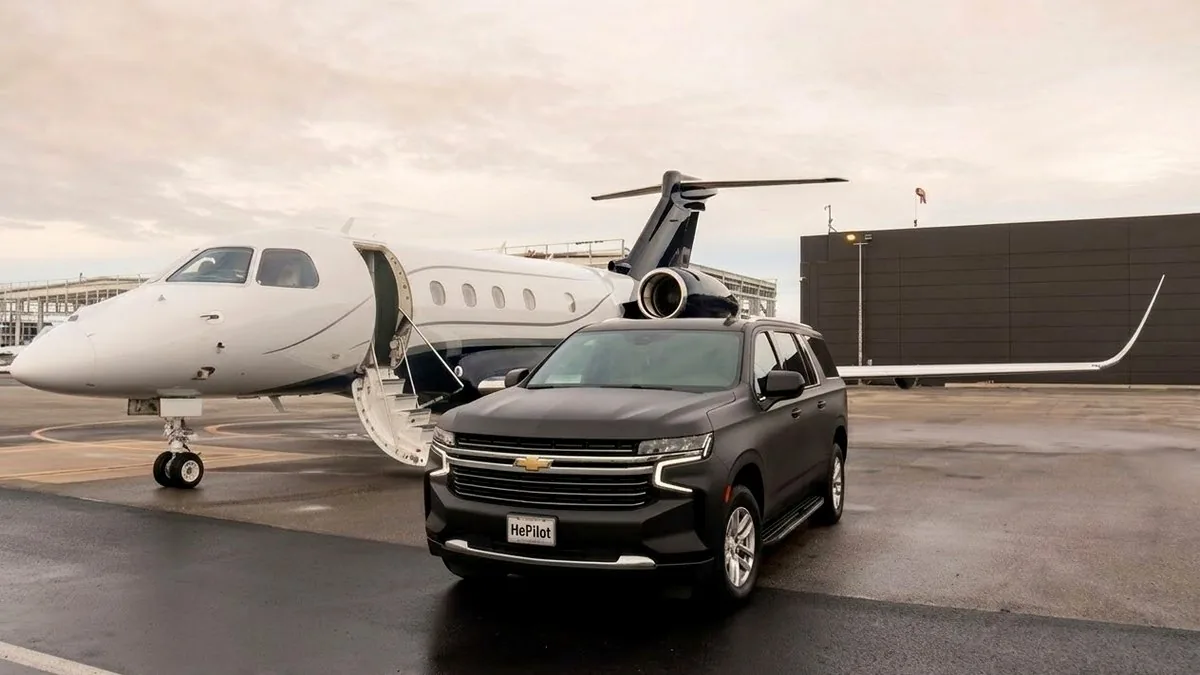
If you are planning an event, send us the dates, pickup points, passenger counts and flight numbers. We will put together a plan and a quote. Start with our services overview, or book an hourly chauffeur directly.
A planning timeline you can copy
| When | What to do |
|---|---|
| 6 to 8 weeks out | Draft the movement map. Identify VIPs, speakers and guests who need assistance. Request quotes. |
| 3 to 4 weeks out | Confirm vehicles, pickup points and chauffeur assignments. Share the event schedule with the provider. |
| 1 to 2 weeks out | Collect flight numbers. Lock hotel and venue addresses and entrances. Finalize the attendee message. |
| 48 to 72 hours out | Send attendee instructions with chauffeur and vehicle details. Confirm the escalation contacts. |
| Event day | Keep one person on the phone. Track flights. Review the day’s legs each morning. |
| After the event | Collect feedback from guests and assistants. Note what to change in the next movement map. |
For short-notice events, compress the steps but keep the order. The movement map comes first, always.
Common mistakes to avoid
- Planning by distance, not time of day. A short drive in Los Angeles can take far longer at rush hour.
- Vague pickup points. “Meet at the airport” is not a plan. Name the terminal and the exact location.
- No flight numbers. Without them, pickup times are static and delays cause chaos.
- Leaving special needs for the day. Assistance needs advance notice so the right person is in the right place.
- No named contact. If no one answers the phone, a small delay becomes a big one.
- Over-scheduling. Allow time for loading luggage, greetings and the occasional unexpected stop.
FAQ
How far ahead should I book corporate event transportation?
Book as soon as your dates and venue are fixed, ideally several weeks ahead for multi-day events. Early booking gives you more choice of vehicles and chauffeurs, and time to refine the plan as the guest list changes. You can still add legs later, so confirm the change process with your provider.
What should I include when asking for a quote?
Give the event dates, venue, every pickup and drop-off, times, passenger counts, luggage, flight numbers and any special needs. State whether you want point-to-point transfers or hourly service. The more complete the request, the more accurate the quote.
Is a private chauffeur or a group shuttle better for a corporate event?
It depends on who is traveling. Private chauffeurs suit executives, speakers and VIP guests who need punctuality, privacy and personal assistance. Many events use a chauffeur for those legs and keep the rest of the plan simple around them.
How do I make sure a transportation provider is properly licensed in California?
Ask for the company’s carrier number and check it with the California Public Utilities Commission, which licenses charter-party carriers. Ask for proof of insurance as well. A professional provider will share both without hesitation.
Sources
- Corporate Event Transportation: Buses, Shuttles & More (Offsite)
- Transportation for Your Event (Executivevents)
- Licensing Requirements for Carriers Under CPUC Authority
- Passenger Carrier FAQs (CPUC)
Pingback: Red Carpet Transportation: How to Arrange It in Los Angeles - HePilot Chauffeur Service
Pingback: Traslado privado de LAX a Disneyland: cómo reservarlo bien - HePilot Chauffeur Service
Pingback: Chauffeur Service Cost: What You Pay and Why | HePilot
Pingback: Corporate Airport Transfer: How to Arrange One in Los Angeles | HePilot
Pingback: Car Service to LAX: How It Works, What It Costs, How to Book | HePilot