
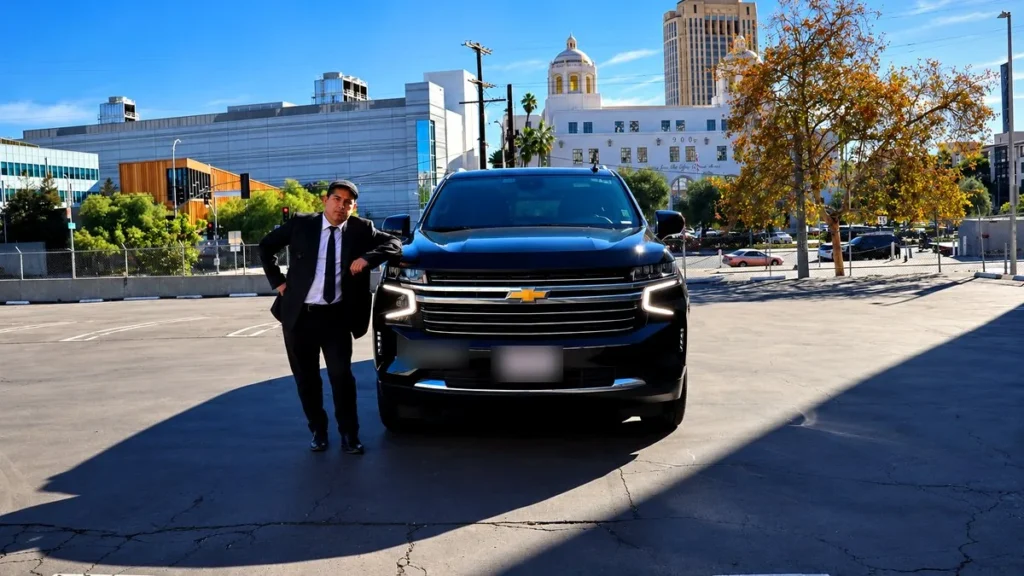
Good executive travel planning comes down to three things: knowing the executive’s preferences before you book, building an itinerary that every person on the trip can act on, and locking down ground transportation with the same care as the flight. Ground transport is the leg that most often decides whether the executive walks into the meeting calm or late. In Los Angeles, a pre-arranged chauffeur who meets your executive at arrivals, such as the hourly and airport chauffeur service we run at Hepilot, takes that leg off your plate.
This guide is for executive assistants, office managers, and hotel and concierge teams who arrange trips for other people. It covers the workflow from approval to the ride home, then goes deeper on business meeting transportation.
TL;DR
- Collect trip facts and build a preference profile for each executive before you open any booking tool.
- Book in sequence: flights, then lodging, then ground transport, and reconfirm everything 24 to 48 hours before departure.
- Build one itinerary document with confirmation numbers, driver contact, meeting contacts and a backup plan.
- Plan meeting rides backward from the fixed meeting time, with a buffer on both sides.
- For LA arrivals and meeting days, a pre-booked chauffeur with a named driver and meet and greet removes the most common failure points.
Table of Contents
- What executive travel planning involves
- Phase 1: Approval and trip facts
- Build a preference profile once, reuse it every trip
- Phase 2: Book in sequence
- Phase 3: One itinerary everyone can use
- Phase 4: Support during the trip
- Business meeting transportation in Los Angeles
- Hourly service for meeting days
- Common planning failures and how to avoid them
- Tools and templates
- Promo: Ground transportation handled in LA
- Our view on executive ground transportation
- FAQ
- Sources
What executive travel planning involves
Executive travel planning is the work of turning “I need to be in Chicago Tuesday” into a trip that runs without the executive having to think about it. It includes approval, booking, documents, itinerary, on-the-ground support and after-trip cleanup. A four-phase model is common: request and approval, booking and logistics, pre-departure preparation, and real-time support during the trip.

The point of the phases is that mistakes get cheaper to fix the earlier you catch them. A wrong date found at approval costs a conversation. The same error found at the airport costs a missed meeting.
Phase 1: Approval and trip facts
Before you touch a booking tool, confirm five things. One assistant training guide lists them and calls skipping this step the top source of travel errors:
- Exact dates, including whether the executive must arrive the night before.
- Every meeting location and time, checked against the local time zone.
- Whether anyone else is traveling: other executives, board members, clients.
- Budget limits or corporate travel policy.
- Whether the trip is booked through a corporate travel agency or independently.
Add the approval chain. For board, investor or key-client trips it may include the CFO or COO depending on spend, and the same guide recommends having the approval conversation explicitly rather than inferring approval from a calendar request. That avoids rework when the objective was unclear.
Start collecting traveler details early. One travel checklist suggests beginning four to six weeks before departure. For international trips it advises checking that the passport is valid at least six months past the travel date, and looking up visa and vaccination requirements.
Build a preference profile once, reuse it every trip
The habit that saves the most time is a written profile for each executive. Rebuilding preferences from memory at 9 p.m. is how wrong seats and wrong hotels happen. A solid profile covers:
- Ranked airlines, loyalty numbers, seat preferences.
- Hotel chains, loyalty numbers, room preferences such as floor level or a quiet room.
- Passport and visa details, and Known Traveler Numbers.
- Dietary restrictions.
- Ground transportation preference: car service, rental or rideshare.
- How the executive wants the itinerary delivered: email, calendar invite, print, or all three.
These items come from several assistant guides, including Navan’s tips for executive assistants and the Executive Assistant Institute. Navan also suggests a five-minute debrief after each trip so the profile gets updated the same day, while details are fresh.
If you support more than one executive, keep one profile each. A multi-executive playbook adds policy and payment rules, accessibility needs and emergency contacts to each profile.
Two ground-transport items belong in every profile: whether the executive wants to be met inside the terminal or at the curb, and whether they prefer to ride alone or take calls in the car. Both change how you book the car.
Security programs are worth setting up early too. TSA PreCheck membership lasts five years, so a single enrollment covers a long run of domestic trips. Put the Known Traveler Number in the profile so it flows into every booking.
Phase 2: Book in sequence
The usual order is flights, then lodging, then ground transport. Flights set the arrival time, the hotel should sit near the key meeting locations, and the car is built around both. Two rules from Reed & Mackay’s corporate travel strategies are worth adopting:
- Avoid tight connections, and leave breathing space around late landings and early board meetings.
- Choose refundable or changeable fares when the schedule might move.
When the schedule is uncertain, Engine’s booking checklist adds change protection and calendar invites that carry the confirmation numbers and vendor contacts.
Book the car in the same sitting as the flight, not the day before. A named, pre-arranged ride is a fixed point in the itinerary. A ride you plan to request on arrival is a hope.
Phase 3: One itinerary everyone can use
The itinerary is the document the executive, the driver, the hotel and you all work from. A practical template guide says the ground transfer fields should include:
- Driver cell number and vehicle plate.
- Meet point and pickup address.
- The handoff window.
Each meeting line should have the venue address, arrival window, host contact, a backup host contact and a hard end time. The same guide advises padding ten minutes before every handoff, which is cheap insurance against a late car or a crowded lobby.
Navan recommends a one-page, mobile-friendly trip brief for the executive: flight numbers and terminals, hotel name and address, pickup times and driver contact, meeting addresses and agenda times, a 24/7 support number, and a backup plan for the day’s most important meeting.
Finish with a confirmation sweep. Reed & Mackay suggests reconfirming ground transport, restaurant bookings and high-priority meetings 24 to 48 hours ahead. This is the moment to confirm the pickup time, the meeting point and the driver’s contact number with your car service.
Phase 4: Support during the trip
During the trip you are the single point of contact. Aurora’s guide recommends active monitoring from 24 hours before departure, and acting immediately when disruptions hit: hold alternates and escalate rather than wait. Bring the executive a recommendation, not just a status update.
This is where a pre-arranged chauffeur earns the booking. When a flight lands late, the pickup is already known to the car service and the driver already has the executive’s name and your number. You do not start from zero in a rideshare app while the executive stands at the curb.
Business meeting transportation in Los Angeles
This is the part most generic guides skip. Los Angeles is a driving city, and a meeting across town is a different problem from a meeting across a downtown block.

Plan backward from the meeting
Start with the time the executive must be in the room, then work backward:
- Subtract a buffer so they arrive before the start time, not at it.
- Subtract drive time for the actual hour of day.
- Subtract pickup and loading time, including luggage if they are coming from an airport or hotel.
- Add the ten-minute handoff pad from the template above.
Drive time is the number that moves. One local traffic guide puts the morning peak at roughly 7:00 to 9:30 a.m. and the evening peak at roughly 4:00 to 7:30 p.m., starting as early as 3:00 p.m. on Fridays. Check the real conditions for the day of travel and plan the pickup time around them, not around a map estimate from a quiet hour.
Match the vehicle to the group
Count passengers and bags first, then think about what happens in the car. A single executive taking calls needs a different vehicle than three people reviewing a deck on the way to a client. Our fleet page shows the vehicle options, so you can match the car to the group and the occasion.
Coordinate airport, hotel and venue
Most multi-stop days fail at the handoffs. Write each handoff into the itinerary as its own line:
- Airport to hotel: the terminal, the meet point, and who the driver is looking for.
- Hotel to meeting: the lobby pickup time and the venue entrance, since large campuses and towers often have several.
- Meeting to the next stop: the hard end time and the driver’s standby plan if the meeting runs over.
For airport arrivals, a driver who meets the passenger in person is easier than a curbside rendezvous at a busy terminal. We describe how that works on our LAX meet and greet page, and our airport transfer page covers what to specify when you book.
What to confirm with a car service
When you arrange a business meeting car service, confirm these points in writing:
- Who on your team is authorized to book and change rides.
- How far ahead you need to book, and how last-minute requests are handled.
- How changes and after-hours requests are made.
- How the driver will be identified at pickup.
- How billing works, and who receives the receipts.
- Whether the executive’s itinerary and passenger details are kept confidential.
For recurring corporate use, it helps to have these rules agreed once rather than renegotiated per trip. Our corporate event transportation guide covers the planning side when the ride involves a group.
Hourly service for meeting days
Some days do not fit a point-to-point ride: three meetings across the region, a site visit between a morning flight and an evening dinner, or a day where the schedule shifts as the meetings run. A chauffeur booked by the hour stays with the executive through the day. The car waits, the luggage stays secure, and the plan can adjust without a new booking each time. Our Hourly Chauffeur Service is built for that kind of day, and you can see how chauffeur cost is structured before you request a quote.
Common planning failures and how to avoid them
| Failure | What prevents it |
|---|---|
| Wrong date or time zone | Confirm dates and map every meeting to local time before booking |
| Tight connection or late landing before a key meeting | Buffer time, refundable fares, a named pre-booked car |
| Missed pickup at a busy terminal | Meet point and driver identification in the itinerary |
| Preferences forgotten | Written profile per executive, updated after every trip |
| Plans that change mid-trip | Reconfirm 24 to 48 hours ahead, keep a backup plan on the one-page brief |
| Confusion over who does what | Escalation contacts visible to everyone |
Tools and templates
You do not need heavy software to start. A shared document with the sections above works for one or two executives. As volume grows, tools fall into a few categories. One 2026 overview lists all-in-one corporate travel platforms, travel management companies, expense-only platforms and calendar or itinerary apps, with typical per-user monthly prices for each. Pick the lightest tool that still keeps every confirmation number and contact in one place.
Whatever you use, keep a single source of truth, and keep the car service’s contact details in it.
Promo: Ground transportation handled in LA
When your executive lands at LAX or has a day of meetings across Southern California, we provide pre-arranged private chauffeur transportation: airport transfers, business transportation and hourly chauffeur service. Our chauffeurs are professional and easy to identify at crowded locations, we help with luggage, and we provide complimentary bottled water. Assisted transportation is available for seniors and passengers who need extra support. You can book online or by phone, and see our services for the full list.

For airport trips specifically, read our airport chauffeur service guide and our guide to car service to LAX.
Our view on executive ground transportation
In our work with business travelers, we treat the car as part of the executive’s day, not an errand beside it. A flight can be perfect and a trip can still go wrong in the first thirty minutes after landing.
That is why we focus on the details that assistants worry about: a pickup that is pre-arranged, a driver who is easy to identify at a crowded airport, help with luggage, and a vehicle that suits the passenger and the occasion. Our service is built around punctual pickups and professional chauffeurs, so the person who made the booking can stop tracking the ride.
We also think transparent booking and pricing matter as much as the car. An assistant needs to know what the ride will involve before it happens, and to reach a person by phone or online when the plan changes.
For executives, hosting clients or guests, and for people who need extra support getting from one place to the next, a private chauffeur makes the whole itinerary easier to run.
Hepilot
FAQ
How far ahead should I start planning executive travel?
Start collecting traveler details about four to six weeks before departure, according to one assistant checklist. Book flights and the hotel first, then add the car as soon as the arrival time is fixed. Reconfirm everything 24 to 48 hours before the trip.
What should be in an executive’s itinerary?
Include flight details with confirmation numbers, hotel check-in and check-out times, ground transport arrangements, meeting addresses and contacts, restaurant reservations and emergency contacts. For the car, add the driver’s phone number, the vehicle plate, the meet point and the pickup address. Keep it in one mobile-friendly document.
How do I arrange transportation for an executive’s business meetings in Los Angeles?
Work backward from the meeting time, add buffer time and a realistic drive time for that hour of day, and book a pre-arranged chauffeur with the pickup address, meet point and driver contact in the itinerary. For a day with several stops, hourly chauffeur service keeps one driver and one car with the executive throughout.
What should I confirm when booking a business meeting car service?
Confirm who may book and change rides, how far ahead you must book, how last-minute and after-hours changes are handled, how the driver is identified, and how billing and receipts work. Ask also how passenger and itinerary information is kept confidential.
Can a chauffeur help a senior executive or guest who needs extra support?
Yes. We offer assisted transportation for seniors and passengers who need extra support, along with luggage assistance and meet and greet. Tell us the passenger’s needs when you book so the ride is arranged around them.
Sources
- Executive travel planning: a complete guide
- How to Book Travel as an Executive Assistant
- Work travel 101: The essential travel checklist for executive assistants
- 10 travel management tips for executive assistants
- Booking Travel for Multiple Executives
- TSA PreCheck FAQ
- 12 practical corporate travel strategies for EAs and PAs
- How to Book a Business Trip: A Practical Guide
- Executive Travel Itinerary Template: A Practical Guide
- Executive Travel Planning: What Your Assistant Should Know
- Los Angeles Traffic Guide
- Executive Assistant Job Description
Pingback: Event Transportation in Los Angeles: How to Plan It Well -
Pingback: Transporte corporativo: cómo organizarlo bien en Los Ángeles | HePilot
Pingback: Group Travel Transportation: How to Plan It Well | HePilot