
Traveling with limited mobility goes well when every leg of the trip is arranged before you leave: the flight and your device, the airport, the hotel, and above all the ride at each end. The ride is where trips most often come apart, because it is the one leg nobody hands you. In Los Angeles, a pre-arranged private chauffeur who meets you at the terminal, handles your luggage and takes you door to door removes the least predictable part of the day. If you book travel for an executive, a guest or a parent, this guide gives you the sequence to follow.
TL;DR
- Tell the airline what you need when you book: device size, weight and battery type, plus wheelchair or guided assistance. DOT rules generally do not require advance notice, but notice avoids problems.
- Tell the TSA officer about your condition at the checkpoint. A notification card or medical documentation works as well as speaking up.
- Call hotels to confirm ramps, elevators, door widths and roll-in showers instead of trusting a listing.
- Arrange ground transportation first, not last. A pre-booked chauffeur with a named driver, luggage help and a meet and greet at LAX replaces improvising at the curb.
- Build in rest time. Fewer, slower days make a trip workable.
Table of Contents
- Start with the trip, not the destination
- Flying with a wheelchair, scooter or walker
- Getting around the airport
- The ground transportation problem
- Hotels and daily logistics
- Insurance and documentation
- Arranging a ride in Los Angeles
- FAQ
- Sources
Start with the trip, not the destination
Most guides open with a list of accessible places. For a working traveler, an assistant or a concierge, the destination is already fixed. What you control is the plan around it.
The National Council on Aging’s guide, republished by Travelers United, says that traveling with mobility aids is possible and successful with planning. It points to a handful of steps: research the destination’s accessibility, check in with a health care provider before you go, notify the airline about your device, call hotels, plan ground transportation ahead, buy travel insurance that covers device loss or damage, and tune up your equipment. It also notes that about 30 percent of Americans over 65 who live outside institutions use an assistive mobility device, so you are far from the only one planning this way.
A simple working method is to split the trip into legs: home to airport, airport to gate, flight, arrival airport to ground transport, ground transport to hotel, hotel to every meeting or event, and the return. Portland’s Office of Equity recommends planning each leg, keeping a day-by-day list of requested accommodations with the name of the staff member who confirmed each one, and allowing for places that need two to five days’ notice. Write down who confirmed what. When something goes wrong at 6 a.m., that note is the most useful thing in your bag.
Two more points from the same sources are worth acting on. First, the NCOA advises choosing a compact, foldable device for travel, since the scooter or chair used at home may be too bulky, and practicing with any new device before you leave. Second, Portland’s guidance reminds travelers that access is not only about wheelchairs and ramps. Cognitive, sensory and other disabilities count too, and you should ask for the accommodation you need even if it goes beyond the standard access symbol.
Flying with a wheelchair, scooter or walker
What to tell the airline
The VA’s airport travel guide advises being specific when you make the reservation. Give the wheelchair’s size, weight and battery type. Ask for attendant service to the gate and through security, help boarding with an aisle chair, and an on-board aisle chair if you will need the restroom in flight.
Under the Air Carrier Access Act, it is illegal for airlines to discriminate because of disability, and the rules cover all flights to, from or within the United States. Airlines must provide prompt wheelchair or guided assistance to board, deplane or connect, help with seating accommodations, and safe loading and stowing of assistive devices.
Advance notice is generally not required, but the Department of Transportation says airlines may ask for up to 48 hours’ notice and a one-hour-early check-in for certain things: medical oxygen, stretchers, certain wheelchairs, battery packaging, on-board wheelchairs on planes without accessible lavatories, and groups of ten or more travelers with disabilities. Details are on DOT’s general travel tips page. If you are arranging travel for someone else, assume you need the notice and book early.
Seats
Federal regulations require aircraft with 30 or more passenger seats to have movable aisle armrests on at least half of the aisle seats in rows where passengers with mobility impairments may sit. Carriers must let you identify those seats by seat and row number. Ask for the exact seat in writing, and do it at booking, not at the gate.
What changed with the wheelchair rule
DOT’s final rule on safe accommodations for air travelers using wheelchairs was published on December 17, 2024. It was issued to address problems such as mishandled devices and improper transfers to and from seats and aisle chairs, according to the Federal Register notice. When a wheelchair or scooter is mishandled, airlines must tell the passenger in writing about their rights, including filing a claim and getting a loaner chair.
Some provisions are on hold. In a notice dated August 4, 2026, DOT paused enforcement of four provisions until April 30, 2027, along with the flight-attendant training mandate for on-board wheelchairs. Everything else, including the protections that existed before the 2024 rule, remains enforceable. Check DOT’s site for the status when you travel, since enforcement dates move.
Looking further out, new single-aisle aircraft with 125 or more seats delivered on or after October 2, 2026 must include an accessible lavatory. That affects the fleet gradually, so do not count on it for any single flight yet.
Getting around the airport
Airports are where limited stamina costs the most. Terminals are long, and the walk from the curb to the gate can be the hardest part of the day. A few habits help.
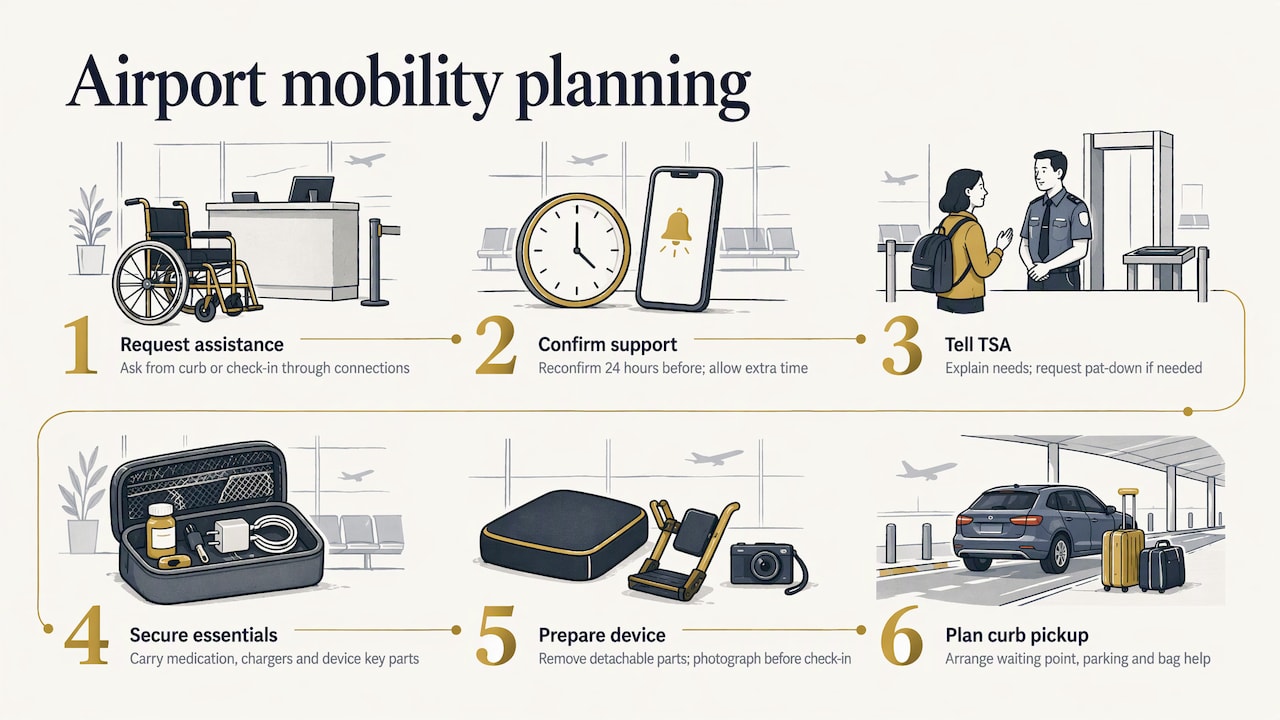
Request assistance when you book, and confirm 24 hours before. Ask for wheelchair or guided assistance from the curb or check-in counter, not just the gate. Then ask for help through security and at any connection. Allow extra time. Airlines may require early check-in for some services, so arrive earlier than you would otherwise.
Tell the TSA officer what you need. TSA says all passengers go through screening, but you or a companion can tell the officer about your disability or medical condition verbally, with the TSA Notification Card, or with medical documentation, and work out the best way to complete screening. The body scanner requires being able to stand and walk unassisted and to hold your arms overhead for five to seven seconds without support. If that is not possible, you will receive a pat-down instead. If anything goes wrong, ask for a supervisor at the checkpoint.
Keep the essentials on you. Medication, chargers and the device’s key parts should travel in your carry-on. Remove detachable parts, such as cushions and footrests, before the device is stowed, and photograph the device before check-in so any damage claim is documented.
Plan the curb, not just the gate. Airport assistance usually ends at the terminal door. Who is waiting outside, how far they are parked and whether they will carry your bags are the questions that decide how the arrival goes. That is the next problem to solve.
The ground transportation problem
A shuttle-and-rideshare scramble is fine when you can walk 400 feet and lift a suitcase. It is a poor fit when you can’t. Strangers in unmarked cars, curbs a long way from the terminal and a driver who stays in his seat while you handle three bags are the usual points of failure.
Public options exist. Federal Transit Administration guidance states that paratransit eligibility depends on your functional ability to use fixed-route bus service, not on a medical diagnosis, and each agency sets its own application process. Paratransit is a shared-ride service. One agency’s rider guide describes pickup as close as possible to the origin, limited driver assistance (no escorting into buildings) and a recommended maximum trip time of 90 minutes. That is a public benefit designed for local residents, and not a service built for a visiting executive with a 2 p.m. meeting.
For business travelers, hotel guests and anyone with a tight schedule, the practical answer is a pre-booked private driver. Here is what to settle with the provider before the trip:
- Who is the driver and how will you find them? At LAX, with thousands of people at the curb, a clearly identified driver makes the difference between a two-minute pickup and twenty minutes of searching.
- Will they meet you inside, and will they handle the bags? Meet and greet plus luggage assistance take the longest walk and the heaviest lift off you.
- What help do you need getting in and out of the vehicle? Say so at booking, not at the curb.
- What are you bringing? List the walker, folding chair or scooter at booking so the vehicle is chosen to fit.
- What is the flight number? Pre-arranged pickup is tied to your arrival, so a delay does not strand you.
- What will it cost, in writing? Get the price before the day, not after.
For Los Angeles, our airport chauffeur service is built around exactly these points: pre-arranged pickup, professional chauffeurs who are easy to identify at crowded locations like LAX, luggage assistance, and complimentary bottled water in the car. We also offer assisted transportation for seniors and passengers who need extra support. If the traveler is an older parent or executive who tires easily, airport transportation for seniors explains how that booking works.
Hotels and daily logistics
A hotel listing that says “accessible” tells you very little. The NCOA guide recommends calling the property to confirm ramps, elevator access, door widths and roll-in showers, and to confirm that ADA-compliant rooms are actually reserved for you. Do that by phone, then follow up by email so you have the answer in writing. Portland’s guidance supports the same habit: record who confirmed each accommodation.
Then plan the days:
- Cluster meetings. Put them within a short distance of the hotel, and leave an hour between them.
- Schedule rest. The NCOA guide includes rest days in its recommendations, and a half-day buffer after a flight is wise.
- Plan every transfer. Hotel to the first meeting, meeting to dinner, dinner back to the hotel. A single driver for the day can remove the need to re-book each leg.
- Carry copies. Medication list, physician’s contact, insurance details and the written confirmations.
For hotel concierge teams and assistants arranging this for a guest or boss, a fixed itinerary shared with the driver ahead of time is better than relaying changes by text. Hourly chauffeur service fits days with several stops, since the same driver stays with the guest. For the planning side, our executive travel planning guide covers how assistants structure the itinerary around the car.
If the trip goes beyond Los Angeles, such as a cruise or multi-stop vacation, a travel planner who coordinates custom trip planning across flights, accommodations and transfers can reduce the number of calls you make.
Insurance and documentation
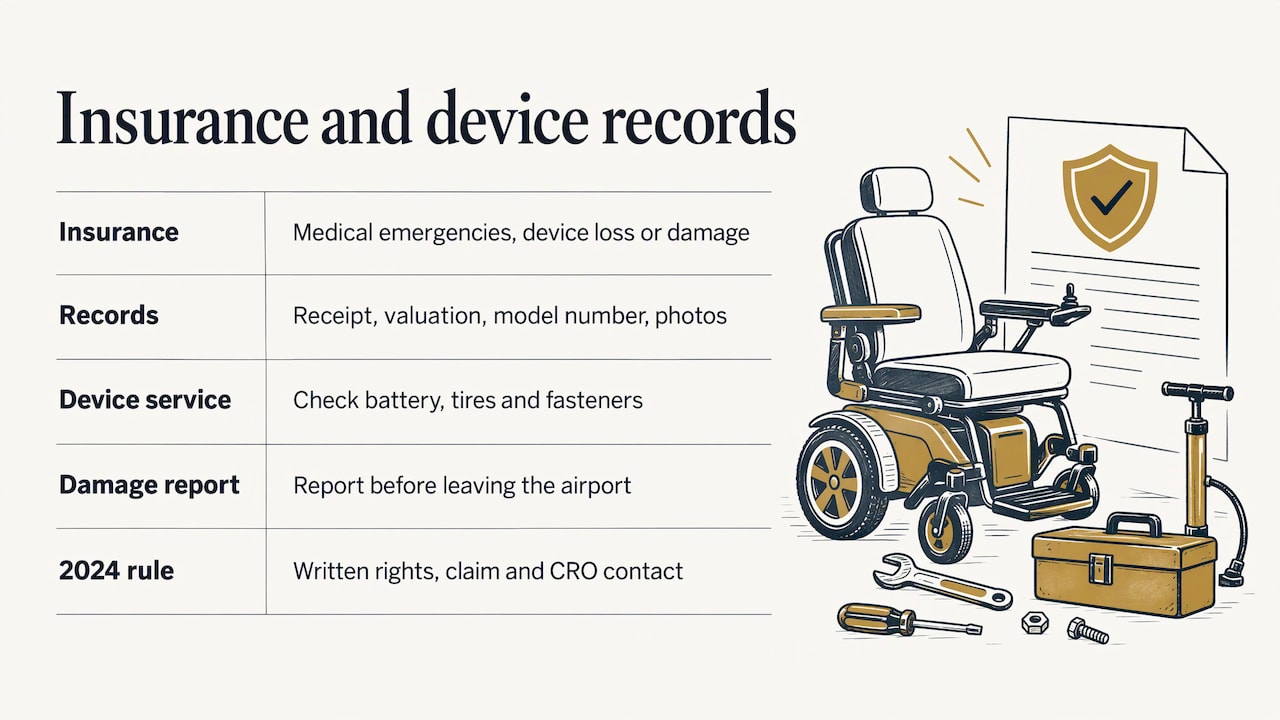
The NCOA guide advises travel insurance that covers medical emergencies and loss of or damage to your device. Read the policy for your specific equipment value, since power chairs and scooters can cost far more than standard baggage limits. Keep the receipt or valuation, the model number and photographs. Before leaving, have the device serviced: check battery, tires and fasteners.
If an airline mishandles your device, the 2024 rule requires written notice of your rights, including the right to file a claim and contact a Complaint Resolution Official. Report damage before leaving the airport and ask for the written form.
Our view: the ride is part of the trip
People planning accessible travel spend hours on flights and hotels and ten minutes on the car. We think that is backwards. The flight is regulated, the hotel is on the phone, but the ride from the terminal is the part with no safety net: no one assigned to find you, no one to carry the bag, no one who knows you need an arm on the curb.
That is why we focus on the basics that matter most to a passenger who needs extra support: a pre-arranged pickup timed to the flight, a chauffeur who is easy to identify in a crowded arrivals area, luggage assistance, meet and greet, and assisted transportation for seniors and passengers who need a little more help. We also offer premium vehicle options, so the car can be chosen to suit the passenger and the occasion.
When an executive assistant or a concierge tells us what the traveler needs ahead of time, the day runs smoothly. Tell us early, and we plan around it.
Hepilot
Arranging a ride in Los Angeles
HePilot provides private chauffeur transportation across Los Angeles and Southern California, from pre-arranged airport transfers to hourly service for meetings, events and special occasions, including assisted transportation for passengers who need extra support. Bookings are made online or by phone. For arrivals, airport transfers are the place to start. To see the vehicle choices, visit our fleet, and for pricing, read what chauffeur service costs and why.

When you book, tell us the flight number, the number of bags, any mobility device and the kind of help the passenger needs getting in and out of the car. That is all we need to plan the pickup.
FAQ
How do you travel with limited mobility?
Plan each leg of the trip separately and confirm every accommodation in writing. Notify the airline about your device, call hotels about access features, arrange ground transportation in advance, and schedule rest time. The NCOA guide also recommends a pre-trip check-up and insurance covering your device.
Do I have to tell the airline in advance that I use a wheelchair?
Under DOT rules, advance notice is generally not required for wheelchair assistance. However, airlines may require up to 48 hours’ notice for specific accommodations such as medical oxygen or certain wheelchairs. Telling the airline when you book is the safer course, because it lets them prepare the right equipment.
How do I get around an airport if I can’t walk far?
Request wheelchair or guided assistance from your airline for the curb, security and gate, and tell the TSA officer about your condition at the checkpoint. A pre-booked driver who meets you at arrivals and handles your luggage covers the leg after you land.
Can a private chauffeur help a senior or someone who needs extra support?
Yes. We offer assisted transportation for seniors and passengers who need extra support, along with luggage assistance and meet and greet. Tell us what the passenger needs when you book so we can plan the pickup around it.
Sources
- NCOA guide to mobility-friendly travel, via Travelers United
- Mobility-friendly travel guide from the National Council on Aging
- Accessible Travel in Portland and Beyond, Portland.gov
- Traveling with a Disability, U.S. Department of Veterans Affairs
- Traveling with a Disability, U.S. Department of Transportation
- General Travel Tips for Persons with Disabilities, U.S. Department of Transportation
- 14 CFR Part 382, Nondiscrimination on the Basis of Disability in Air Travel
- Ensuring Safe Accommodations for Air Travelers with Disabilities Using Wheelchairs, Federal Register
- DOT final rule on wheelchair accommodations (PDF)
- Disabilities and Medical Conditions, TSA Cares
- Frequently Asked Questions, Federal Transit Administration
- ADA Rider’s Guide, RTA New Orleans