

A corporate airport transfer is a pre-booked private ride between the airport and a set destination, arranged ahead of time by the traveler, an assistant or the company. For a Los Angeles trip, the version that works is one where the driver is named in advance, tracks the flight, is easy to find at the terminal and takes the luggage. That is how we run airport transfers at Hepilot. The rest of this guide covers the process, what to put in the booking and what to confirm.
TL;DR
- A corporate airport transfer is pre-booked ground transportation between an airport and a specified destination. The flight itinerary is what the pickup time hangs on.
- Give the booker’s details, the passenger’s name and phone number, the flight number, the terminal, the number of bags and the destination address. Say whether anyone needs extra assistance.
- Plan for delays: the driver should follow the flight and move the pickup time with it, so nobody has to rebook.
- A private transfer costs more than a ride-hail fare. What the extra pays for is a known driver, a meet-and-greet and one point of contact for the whole trip.
- Hepilot serves Los Angeles and Southern California with airport transfers, hourly chauffeur service and business transportation.
Table of Contents
- What a corporate airport transfer is, and who books one
- How the process works, step by step
- What to give the driver: a booking checklist
- Flight delays, changes and luggage
- Private transfer, taxi or ride-hail: how the options compare
- When a corporate transfer is the right call
- What to confirm before you book
- Our perspective
- Book a corporate airport transfer with Hepilot
- FAQ
- Sources
What a corporate airport transfer is, and who books one
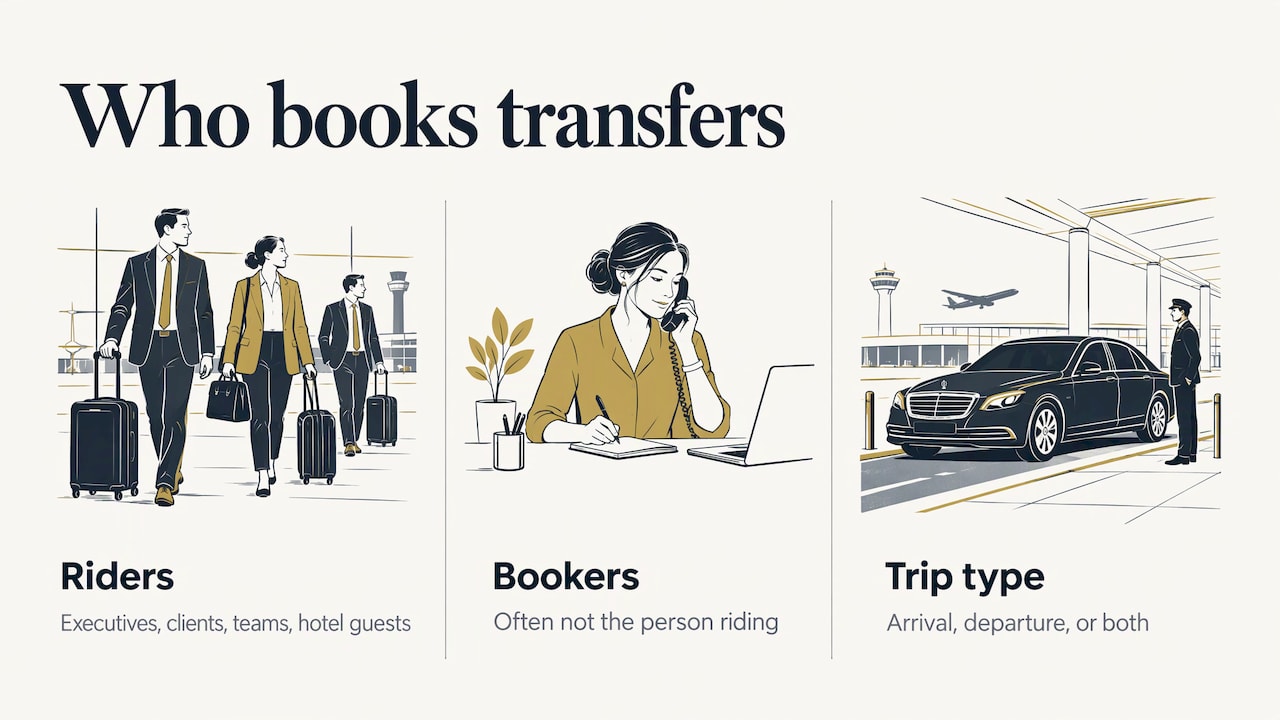
The term covers any airport ride that a business or its representative arranges in advance. The passenger might be an executive flying in for meetings, a client being collected on arrival, a team traveling together or a hotel guest whose concierge made the booking.
The person who books is often not the person who rides. Executive assistants, office managers and hotel concierge teams do most of the arranging. That changes what a good service looks like. The booker is not in the car and cannot fix problems in person. They need confirmations, a driver they can name and a phone number that someone answers.
The ride can be an arrival, a departure or both. Many companies book the pair together so the return trip is not left to the last evening of a trip.
How the process works, step by step
Here is the routine from first request to drop-off. At each step we note where it usually goes wrong.
1. Collect the trip details before you book
Start from the itinerary. The flight itinerary is the anchor for pickup timing, so you need the airline, flight number, arrival or departure date and terminal. For a departure, you also need the pickup address and the time the traveler wants to be at the airport.
Where it goes wrong: a booking made from a calendar entry that says “arrives 4 p.m.” with no flight number. The driver then has nothing to track.
2. Name the passenger and a contact
Put the passenger’s full name and mobile number on the booking. Add the booker’s number as well. If the passenger is a guest of your company, say so and say who they are meeting.
Where it goes wrong: only the assistant’s number is on file, and the driver cannot reach a passenger who has just landed and turned their phone on.
3. Count passengers and bags
Give the number of travelers and the number of checked bags, carry-ons and any oversized items such as sample cases, display equipment or golf clubs. The vehicle is chosen from this, so an exact count matters more than a guess. We offer premium vehicle options, and the booking details tell us which one fits.
Where it goes wrong: four executives with one rolling bag each are booked into a car sized for two with luggage in mind.
4. State any assistance needs
If the passenger is a senior, has limited mobility or needs extra support through the terminal, say so when you book. Our assisted transportation is built for these passengers, with attentive help from curb to car and at the destination.
Where it goes wrong: needs are mentioned only when the driver arrives, when nothing can be changed.
5. Get a written confirmation
After booking, you should have a confirmation that repeats the date, time, pickup point, destination, passenger name and contact numbers. Read it against your notes. A transposed terminal or a wrong date is far cheaper to fix a week out than at the curb.
6. Before the trip: confirm the driver and pickup plan
The passenger should know who is collecting them and how they will find each other. At busy airports such as LAX this is the step that saves the most stress. We focus on easy driver identification in crowded arrival areas, and for travelers who want to be met inside, our LAX meet and greet service covers that.
7. Arrival or departure day
On an arrival, the driver tracks the flight, meets the passenger, helps with luggage and drives to the destination. On a departure, the driver arrives at the agreed time, loads the bags and gets the traveler to the right terminal. Our chauffeurs provide luggage assistance, and each passenger has complimentary bottled water in the car.
8. After the ride
For business travel, keep the confirmation for expense reports. If the booking was for a series of trips, review the pattern: which ones ran tight, which needed a larger vehicle, which passengers wanted the same driver again.
What to give the driver: a booking checklist
This is the information an assistant or office manager should have in hand. Most of it takes under five minutes to gather.
| Detail | Why it matters |
|---|---|
| Passenger name and mobile number | The driver can reach them on landing |
| Booker’s name and number | One person to call about changes |
| Airline and flight number | Lets the driver follow the flight and adjust pickup time |
| Terminal (or airport) | Avoids a wrong-terminal wait at a big airport |
| Pickup or drop-off address | Fixes the route and timing |
| Number of passengers and bags | Determines vehicle choice |
| Special items | Sample cases, equipment and anything oversized need space |
| Assistance needs | Lets the chauffeur plan for support |
| Billing reference | Cost center, PO number or trip code for your accounts team |
| Return trip details | Booked together, they are one less thing to chase later |
If you arrange travel for the same executive often, keep these details in a standing template. Our guide for executive assistants goes through how to organize recurring trips.
Flight delays, changes and luggage
Flights move. A transfer that does not move with them fails the one test that matters.
The principle is simple: because the booking is tied to the flight, tracking the commercial arrival lets the pickup time shift when the flight is early or late. That is why the flight number is the most important field on the booking. Without it, a late flight means a driver waiting to an old schedule, or no driver at all.
A few habits make delays painless:
- Give the real flight number, not the planned arrival time. Codeshare flights can carry more than one number, so use the one on the ticket that operates the flight.
- Tell the service about any rebooking at once. A changed flight or a missed connection is a new pickup time. The earlier the service knows, the easier the change.
- Keep a mobile number on the booking that the passenger will answer. The passenger will often be the first to know about a gate change or a long wait at baggage claim.
- Mention bags that may be slow to come. Oversized items and checked sample cases often come later than standard luggage.
On luggage: a corporate traveler often arrives with a laptop bag, a garment bag and a checked case, sometimes with materials for a presentation the next morning. Having the chauffeur handle loading and unloading is part of arriving ready to work. It is a core part of our service.
Private transfer, taxi or ride-hail: how the options compare
People search “is a chauffeur cheaper than Uber?” and the honest answer is no: a pre-booked private transfer costs more than a ride-hail fare. The question that matters for a business is what the extra buys.
Published research gives context for Los Angeles, with the caveat that it describes past conditions, not today’s fares:
- A peer-reviewed 2020 Los Angeles audit of 1,680 trips found ride-hail fares averaging 40% lower than taxi fares, and average pickup waits of 5.7 minutes for ride-hail against 24.3 minutes for taxis. That waiting variance is the point for business travel: an on-demand ride can come quickly or slowly, and you cannot promise a passenger which.
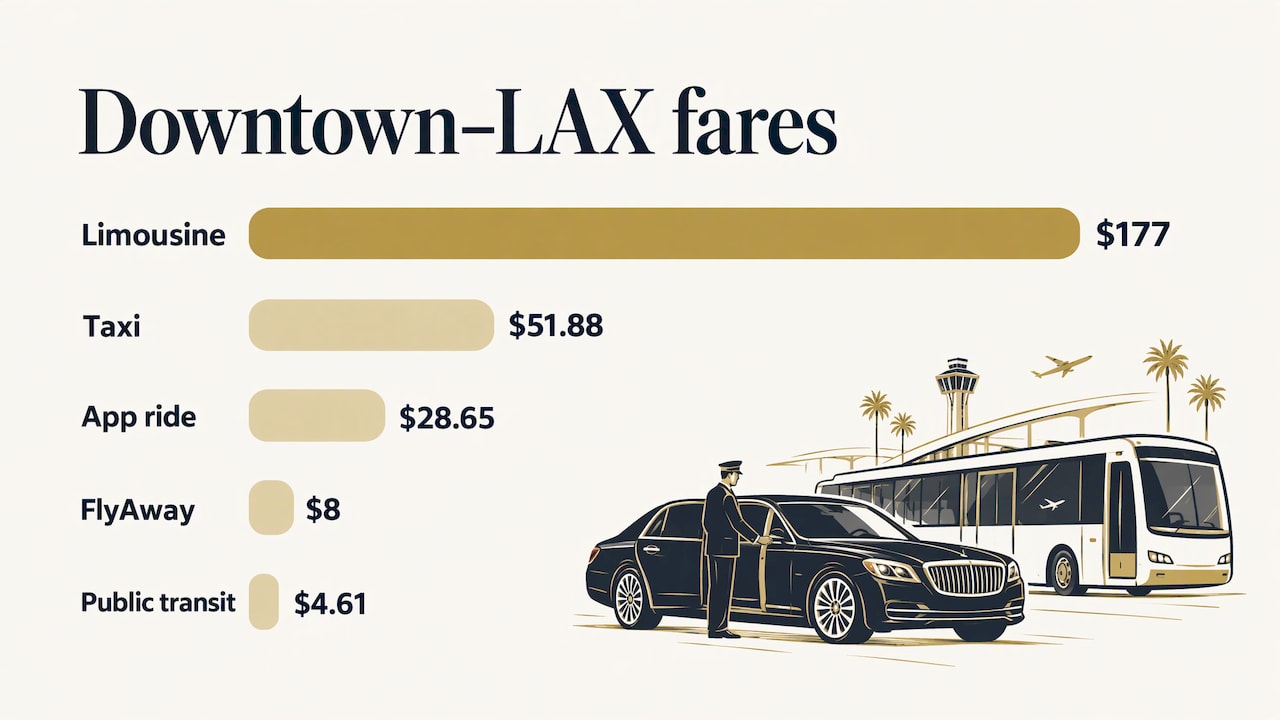
- A 2017 Transportation Research Forum study modeled one-way trips from downtown Los Angeles to LAX for a single traveler. It put a limousine at $177, a taxi at $51.88, an app-based ride at $28.65, FlyAway at $8 and public transit at $4.61. These were estimates for its reference case, not current prices.
- The same study estimated about 30.3 minutes of travel for the limousine, taxi, private shuttle and app-based ride, against 91 minutes for FlyAway and 82.2 minutes for public transit in that modeled comparison.
Two things follow. First, cheaper options exist, and for a traveler with no meeting waiting and a light bag they may be fine. Second, the cost gap is less about the ride than about what surrounds it. A pre-arranged chauffeur transfer gives the booker a confirmed time, a named driver and a person to call, which is what an assistant is paid to secure for an executive.
For a business, the right comparison is the cost of a missed meeting, a stranded guest or an hour of an assistant’s time on hold, set against the fare. We publish the factors that set our rates on our chauffeur service cost page.
When a corporate transfer is the right call
A pre-arranged transfer suits these situations best:
- Executives and senior guests who need to arrive composed, work in the car or take a call on the way.
- Client pickups, where the first impression of your company is the person at arrivals.
- Early and late flights, when you want certainty that someone is there.
- Travelers with luggage, equipment or mobility needs, who benefit from hands-on help.
- Multi-leg days, where the airport is the first of several stops. Our hourly chauffeur service keeps one driver and vehicle with the traveler across the day.
- Groups and events, where several arrivals need to be coordinated. See our guide to corporate event transportation.
If your transfers are part of a larger group trip, such as a retreat or a reward trip, the same discipline applies at a bigger scale. This overview of corporate incentive travel planning shows how transfers fit into the overall itinerary.
What to confirm before you book
Whatever service you use, an arranger should be able to get clear answers to these questions before the trip.
- Who is the driver, and how will the passenger recognize them? At a large airport, a clear identification plan matters more than anything else on the day.
- Where will the pickup happen? Terminal curb, inside baggage claim, or a meet-and-greet with the driver inside the terminal.
- How is the flight tracked, and what happens if it changes? The answer should involve the flight number and a clear contact.
- What does the price include? Ask for the total, in writing, with the items it covers. Transparent pricing means the number in the quote is the number on the invoice.
- Which vehicle will arrive? Match it to passenger and luggage counts.
- Who do I call if something changes? A real person, reachable at the hours your traveler flies.
- Can the same service handle the return, hourly needs and any assisted travel? A single provider for all of it saves coordination.
Our positioning rests on these points: professional chauffeurs, easy driver identification at crowded locations like LAX, premium vehicle selection, transparent pricing and punctual pickups.
Our perspective
Most problems with airport transportation for business are coordination problems, not driving problems. A car that arrives at the wrong terminal, a driver nobody can find in a crowd, a flight that landed an hour late with nobody told: none of these is about the road.
That is why we build our airport transfers around the people who arrange them. The booking carries the flight, the passenger and the luggage. The chauffeur is easy to identify at crowded locations like LAX. Luggage assistance and complimentary bottled water are part of the ride, and passengers who need extra support, such as seniors, get attentive help.
We would rather an assistant spend five minutes giving us complete details than an hour fixing a missed pickup. A transfer done properly is one that the booker never has to think about again after confirming it.
Hepilot
Book a corporate airport transfer with Hepilot
Hepilot provides pre-arranged private chauffeur transportation across Los Angeles and Southern California: airport transfers, business transportation, special events and assisted transportation, plus hourly chauffeur service. You can book through the website or by phone, and you can read how our airport chauffeur service works before you do.

For an LAX arrival, our car service to LAX page has the details specific to that airport.
FAQ
Is a chauffeur cheaper than Uber?
No. A pre-booked chauffeur transfer generally costs more than a ride-hail fare, as the Los Angeles study figures for a limousine versus an app-based ride show. The difference buys a confirmed pickup time, a named driver, luggage help and one contact for the booker.
Are private airport transfers safe?
A pre-arranged transfer means you know in advance who is collecting the passenger and which vehicle will arrive. We focus on clear driver identification and professional chauffeurs, and the booker gets the details before the trip, so the passenger can confirm the driver at the pickup.
Can you hire a driver to drive you around?
Yes. Hourly chauffeur service puts a driver and vehicle at your disposal for a set period, which works for meeting days with several stops, roadshows and visits. We provide it across Los Angeles and Southern California.
What should an assistant include when booking a corporate airport transfer?
Include the passenger’s name and mobile number, the airline and flight number, the terminal, the pickup or drop-off address, the number of passengers and bags, and any assistance needs. Add a billing reference if your accounts team requires one.
What happens if the flight is delayed?
Because the booking is tied to the flight number, the pickup time can follow the flight instead of the original schedule, as the airport-transfer guidance describes. Tell the service about any rebooking right away so the driver has the new plan.
Sources
- Airport Transfer (Navan glossary)
- Hailing a change: comparing taxi and ridehail service in Los Angeles (Brown and LaValle, 2020)
- On-Demand, App-Based Ride Services (Transportation Research Forum, 2017)
- Corporate Incentive Travel: How to Plan a Trip That Motivates